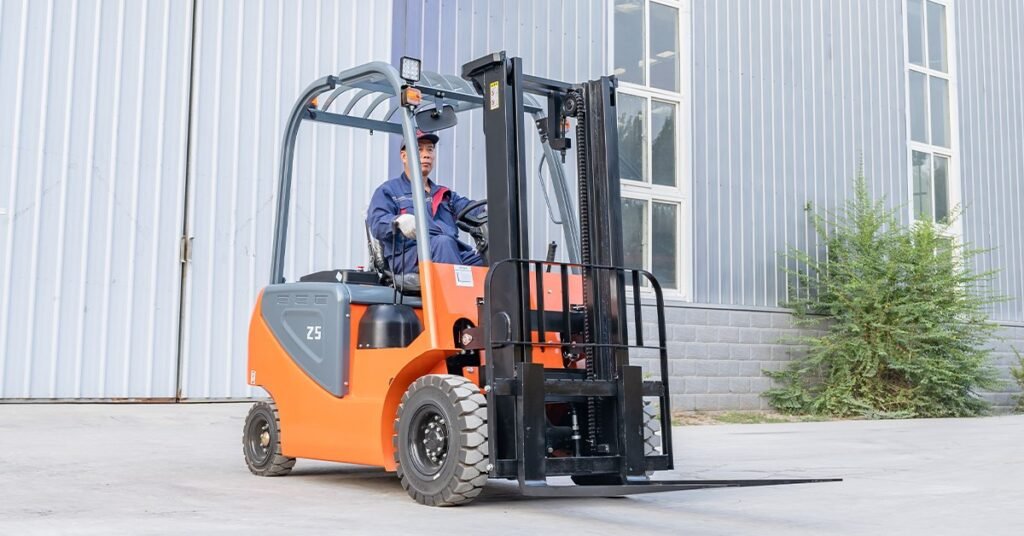
Procuring heavy equipment requires navigating a maze of technical specifications and compliance standards. For outdoor applications involving rough terrain or heavy palletized goods, a diesel forklift remains the industry standard for torque and endurance. However, selecting the right unit goes beyond just engine size. You must evaluate load centers, fuel autonomy, and supplier reliability to ensure operational efficiency. This guide breaks down the critical technical criteria for making an informed B2B investment.
Why Prioritize a Diesel Forklift for Outdoor Operations?
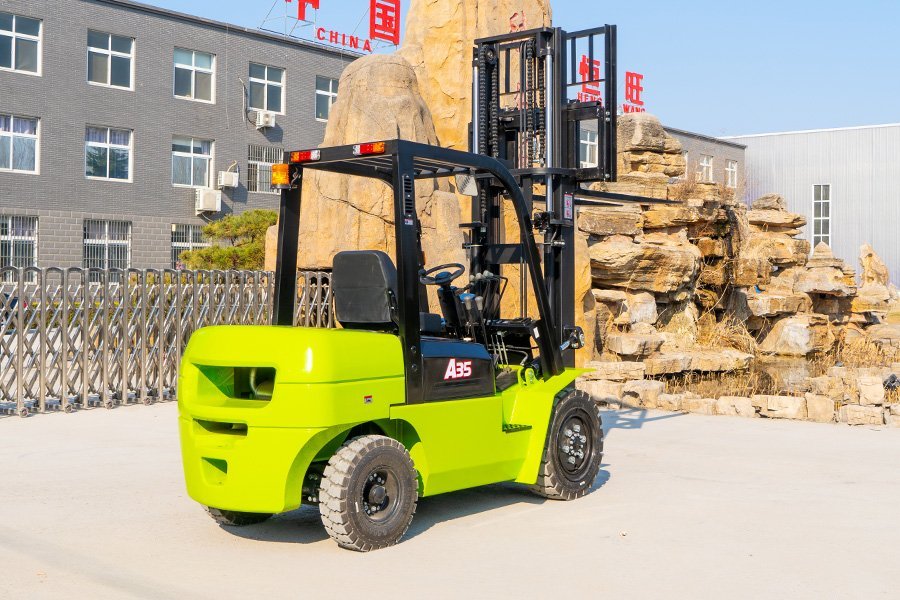
Internal combustion engine (ICE) lift trucks are distinct from their electric counterparts in power delivery and environment adaptability. According to the Industrial Truck Association (ITA), Class 4 and 5 trucks are designed specifically for these rigorous conditions. The primary advantage of a diesel engine is high torque at low RPM. This allows the machine to climb gradients while carrying a full load without straining the drivetrain.
We also see a significant advantage in refueling downtime. Unlike electric batteries that require charging cycles, a diesel unit can be refueled in minutes. This immediate availability is crucial for multi-shift operations in construction or lumber yards. Furthermore, diesel engines typically offer a longer service life when maintained according to manufacturer schedules.
Analyzing the 3.5 Ton Diesel Forklift Capacity
The 3.5 ton diesel forklift is a versatile “middleweight” category. It bridges the gap between light warehousing units and heavy industrial machinery. However, professional buyers must understand that “3.5 tons” is the nominal capacity, not the absolute limit in all scenarios.
Rated Capacity vs. Residual Capacity
You must pay attention to the load center distance. ISO standards (specifically ISO 22915 series) dictate stability testing based on specific load centers, usually 500mm or 600mm. If your load is longer than standard, the lifting capacity decreases significantly. Ignoring this calculation is a leading cause of tipping accidents.
Mast Specifications
When looking for a new diesel forklift for sale, verify the mast type. A 3-stage triplex mast is essential if you need to load containers. It allows for a lower collapsed height while maintaining a high maximum lift. Ensure the hydraulic system matches the mast weight to prevent sluggish lifting speeds.
Understanding Forklift Diesel Tank Capacity
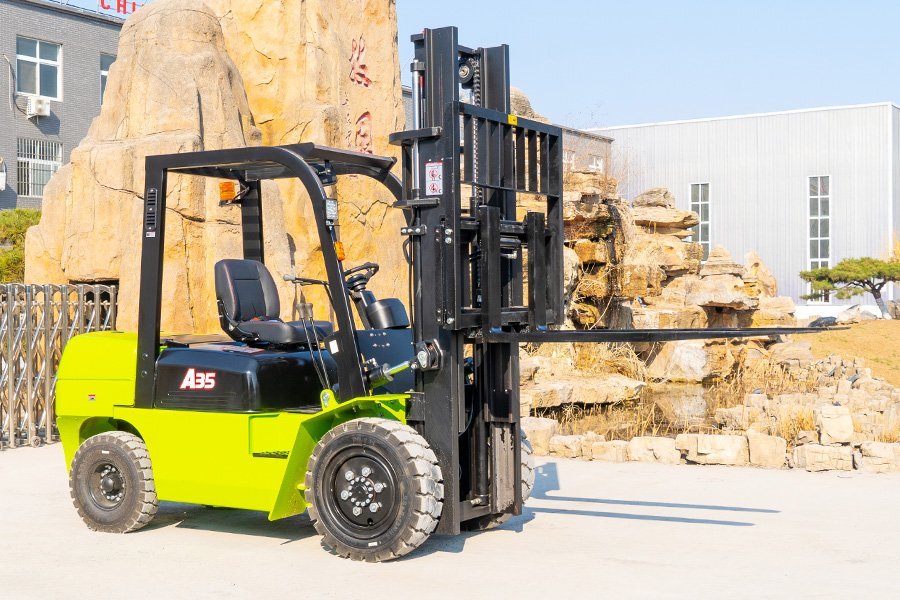
Operational autonomy depends heavily on fuel storage. The forklift diesel tank capacity directly dictates how long your fleet can operate uninterrupted. For a standard 3.5-ton model, fuel consumption generally ranges between 3 to 5 liters per hour, depending on the workload intensity.
Most manufacturers equip this class of forklift with a tank capacity between 60 and 80 liters.
- 60 Liter Tank: Approx. 12-15 hours of operation.
- 80+ Liter Tank: Can often span two full 8-hour shifts.
We recommend verifying the tank material and placement. Steel tanks offer better impact protection on construction sites compared to composite plastics. Additionally, a locking fuel cap is a standard security feature you should insist on to prevent fuel theft.
Vetting a Diesel Forklift for Sale Supplier
Finding the right machine is only half the battle; you also need a reliable partner. A reputable diesel forklift for sale supplier acts as a backbone for your aftermarket support. The initial purchase price is often less important than the Total Cost of Ownership (TCO).
Key Supplier Evaluation Metrics:
- Parts Availability: Can they ship critical filters, seals, and engine parts within 24 hours?
- Compliance Verification: Ensure the engine meets local emission standards (e.g., EPA Tier 4 or Euro V).
- Warranty Terms: Look for coverage that includes the powertrain, not just the frame.
Avoid suppliers who cannot provide detailed technical drawings or certification documents. Transparency regarding the manufacturing origin and component sourcing is a hallmark of a trustworthy B2B vendor.
How to Determine if the HW3.5T Suits Your Fleet
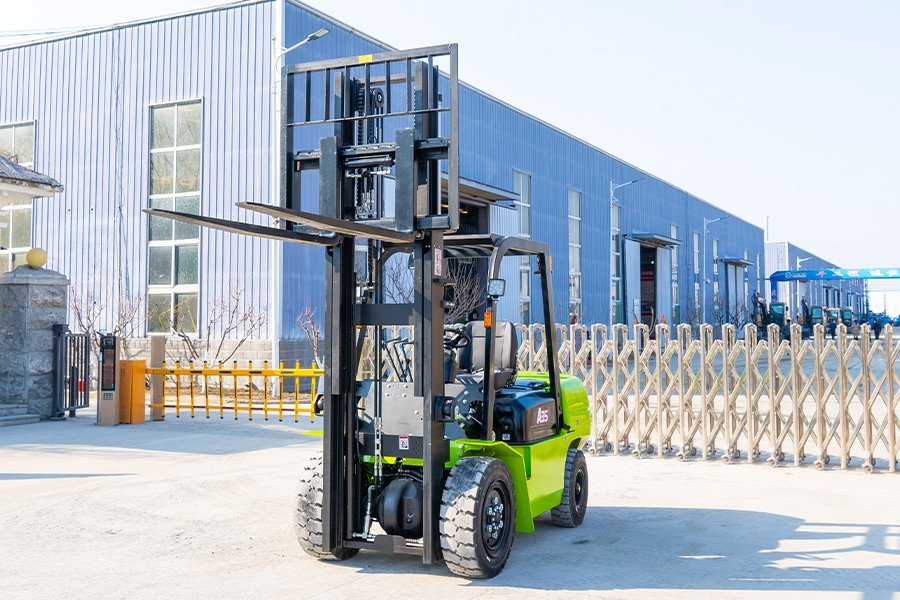
When you are ready to finalize your specifications, you need to match your operational requirements against a specific model’s data. The decision process should focus on the balance between engine output and chassis stability.
Critical Decision Points:
- Engine Reliability: Does the model use a globally recognized engine platform for easy maintenance?
- Ergonomics: Is the cabin designed to reduce operator fatigue during long shifts?
- Chassis Design: Is the counterweight integrated effectively to handle the rated 3.5-ton load safely?
For fleet managers assessing these specific parameters, the HW3.5T Diesel Forklift offers a configuration focused on stability and high-torque output. Reviewing its specific load charts and engine specs will help you confirm if it aligns with your site’s intensity levels.
Summary
Selecting the correct diesel forklift requires a technical analysis of load centers, fuel autonomy, and emission compliance. A 3.5 ton diesel forklift offers an optimal balance of power and agility for outdoor tasks, provided you verify the forklift diesel tank capacity meets your shift requirements. Always vet your diesel forklift for sale supplier for long-term parts support.
FAQ
Q1: What is the average fuel consumption of a 3.5 ton diesel forklift?
A 3.5-ton diesel forklift typically consumes between 3.5 to 5 liters of fuel per hour under average working conditions.
Q2: Can I use a diesel forklift indoors?
Generally, no; OSHA and HSE regulations often restrict indoor diesel use due to carbon monoxide exhaust, unless rigorous ventilation standards are met.
Q3: What is the standard warranty for a new diesel forklift?
Most reputable suppliers offer a warranty of 1 year or 2,000 operating hours, whichever comes first, covering major components like the engine and transmission.
Q4: Why is the load center important for a 3.5 ton forklift?
The load center determines the truck’s actual lifting capacity; if the load’s center of gravity extends beyond the rated distance (e.g., 500mm), the safe lifting weight decreases.
Reference Sources
OSHA (Occupational Safety and Health Administration)
Powered Industrial Trucks – Forklift Classifications
URL: https://www.osha.gov
ITA (Industrial Truck Association)
Class 4 and 5 Internal Combustion Engine Trucks
HSE (Health and Safety Executive)
Rider-operated lift trucks: Operator training and safe use