Operational downtime in heavy construction translates directly to financial loss. For a crawler bulldozer, which often serves as the “anchor” of a site, a single hydraulic failure or undercarriage misalignment can stall an entire earthmoving workflow. Effective bulldozer troubleshooting requires a systematic diagnostic approach, moving beyond surface-level symptoms to address root engineering causes.
From field observations, most mechanical failures in dozers stem from three critical areas: the hydraulic system, the undercarriage, and the power train. Identifying these early is the difference between a minor adjustment and a $20,000 component overhaul.

Common Hydraulic System Failures
The hydraulic system is the lifeblood of the bulldozer, responsible for blade precision and ripper force. When the hydraulics fail, the machine becomes a static weight.
1. Overheating Hydraulic Fluid
If the hydraulic tank feels excessively hot or the cycle times for blade lifting increase, the system is likely cavitating or suffering from internal bypass.
- The Cause: Often a clogged oil cooler, a failing hydraulic pump, or low fluid levels.
- The Solution: Inspect the cooling fins for debris—common in forestry or high-dust environments. Use a flow meter to check pump efficiency. If the pump is pushing less than 90% of its rated GPM (Gallons Per Minute), internal wear is the culprit.
2. Hydraulic Drift
If the blade or ripper slowly sinks while the control valve is in neutral, you are experiencing “drift.”
- The Cause: This usually indicates a leaking cylinder seal or a worn control valve spool.
- The Solution: Perform a cylinder bypass test. If the cylinder remains pressurized but the blade drops, the internal piston seal is compromised. Replace the seal kits immediately to prevent scoring the cylinder walls.
Undercarriage Diagnostics: The 50% Rule
The undercarriage represents nearly 50% of a bulldozer’s lifetime maintenance cost. Troubleshooting this area requires a keen eye for wear patterns on the tracks, rollers, and idlers.
| Symptom | Probable Cause | Technical Solution |
| Track Jumping/Slippage | Loose track tension or worn drive sprockets. | Adjust hydraulic tensioner; check for leaking grease seals. |
| Uneven Bushing Wear | Excessive high-speed reverse operation. | Rotate pins and bushings (“Pin & Bushing Turn”) to extend life. |
| Abnormal Clicking Noise | Dry joints or seized rollers. | Inspect for “snaking” tracks; replace seized bottom rollers. |
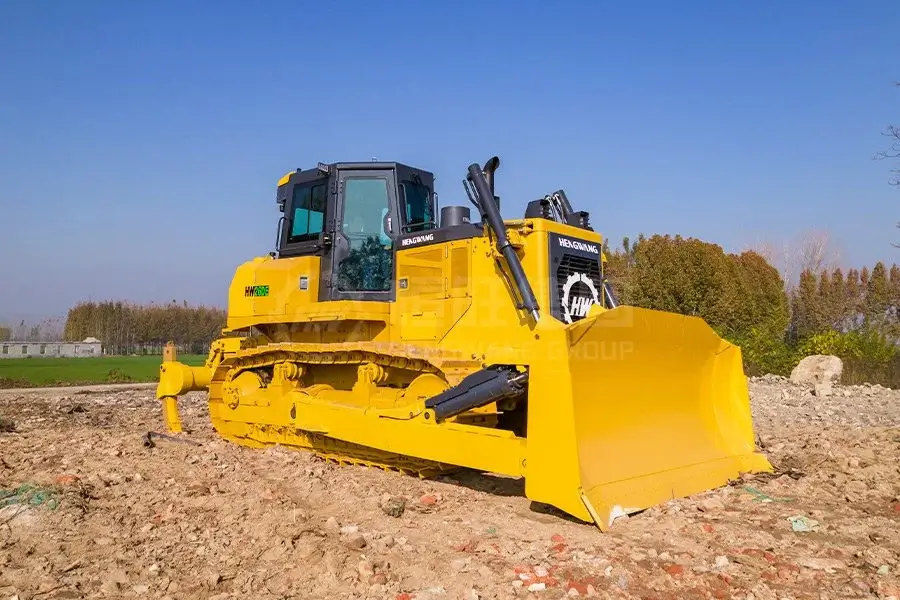
Expert Tip: Modern dozers, such as those engineered by Hengwang, utilize reinforced track frames and high-strength alloy components to mitigate these issues. However, improper tension remains the #1 cause of premature failure across all brands.
Engine and Power Train Troubleshooting
A bulldozer’s engine operates under high load-factor conditions. Troubleshooting power loss involves checking the “Triangle of Combustion”: Air, Fuel, and Compression.
Loss of Drawbar Pull
If the engine revs but the machine fails to push a full load, the issue lies in the transmission or the torque converter.
- Check the Magnetic Screen: Pull the transmission’s magnetic suction screen. If you find “gold” (brass/bronze) flakes, the torque converter is failing. If you find “silver” (steel) flakes, a bearing or gear is disintegrating.
- Torque Converter Stall Test: An experienced technician can perform a stall test to see if the engine reaches the correct RPM under load. Low RPM suggests an engine issue; high RPM suggests transmission slippage.
Exhaust Color Diagnostics
- Black Smoke: Excessive fuel or restricted air intake. Check the turbocharger and air filters.
- Blue Smoke: Oil consumption. Often points to worn valve guides or piston rings.
- White Smoke: Coolant entering the combustion chamber (potential head gasket failure) or unburned fuel due to faulty timing.
Electrical and Control System Errors
With the integration of electro-hydraulic controls (joysticks) and GPS grade control, electrical troubleshooting is now standard.
- Intermittent Controller Response: Usually caused by oxidized connectors or harness chafing near the pivot points.
- Sensor Calibrations: If the blade isn’t responding accurately to “Grade Control,” the IMU (Inertial Measurement Unit) or the cylinder position sensors may need recalibration. Always check the battery voltage first; low voltage often triggers “ghost” error codes in the ECU.
Preventive Maintenance Logic
In the context of industrial manufacturing and OEM equipment, troubleshooting should be a secondary line of defense. The primary defense is a data-driven maintenance schedule.
- Oil Analysis (S•O•S): Regular fluid sampling can detect microscopic metal particles before a catastrophic failure occurs.
- Daily Undercarriage Cleaning: Packed mud hardens and increases track tension by up to 3,000 lbs, accelerating wear on the final drive.
- Cooling System Purge: In high-ambient temperature regions, ensuring the radiator and hydraulic cooler are clear of “blow-by” debris is essential for engine longevity.
Engineering Perspective on Equipment Longevity
When evaluating high-performance bulldozers, such as the crawler models from Hengwang Group, we see an emphasis on structural modularity. This design philosophy simplifies troubleshooting by allowing technicians to swap components—like the final drive or the hydraulic valve block—with minimal site disruption. For procurement managers, choosing machines with accessible service points and localized parts support is as critical as the initial horsepower rating.
FAQ
Q: Why is my bulldozer steering sluggishly to one side?
A: This usually indicates a pressure imbalance in the steering clutches or a failing final drive on one side. Check the steering pump pressure and inspect the final drive oil for metal contaminants.
Q: How often should I check track tension?
A: Track tension should be checked every 10–15 operating hours, especially when moving between different soil types (e.g., from soft clay to rocky terrain).
Q: What causes the hydraulic pump to make a high-pitched whining sound?
A: This is typically “aeration” or “cavitation.” Air is entering the system through a loose suction line or a cracked seal, causing the pump to implode air bubbles, which can destroy the internal components in minutes.
Q: Can I bypass the ECU error codes to keep working?
A: It is highly discouraged. Most modern bulldozer ECUs (Engine Control Units) have “Derate” modes to protect the engine from catastrophic failure. Bypassing these can lead to total engine seizure.
Reference Sources
- Association of Equipment Management Professionals (AEMP): Standards for Heavy Equipment Maintenance and Diagnostics.
- ISO 10263-4: Earth-moving machinery — Operator enclosure environment — Part 4: Heating, ventilating, and air conditioning (HVAC) test method and performance.
- SAE International (Society of Automotive Engineers): J1349 – Engine Power Test Code for Spark Ignition and Compression Ignition.
- Hengwang Group Technical Documentation: Bulldozer Operation and Maintenance Manuals.