The global demand for compact construction machinery has shifted significantly toward Chinese manufacturing hubs. For equipment rental yards, landscaping contractors, and agricultural distributors, understanding the wholesale mini excavator price is no longer just about the lowest sticker figure. It is about calculating the total cost of ownership (TCO) against hydraulic efficiency and engine reliability.
When sourcing from China, the price gap between an entry-level 1-ton unit and a premium high-spec machine can range from $2,500 to over $9,000. This variance is not arbitrary; it is dictated by component sourcing, emission standards, and structural steel quality.
Deciphering the Cost Drivers of Wholesale Mini Excavators
To evaluate a quote effectively, a procurement manager must look beyond the exterior paint. Several technical variables dictate the final wholesale price.
1. Engine Configuration and Emission Compliance
The heart of the machine is the primary price driver. For the North American and European markets, EPA Tier 4 Final or EU Stage V compliance is mandatory.
- Budget Tier: Often utilizes single-cylinder air-cooled engines (like Koop or Changchai). These are cost-effective for domestic or less regulated markets but lack the longevity required for heavy rental use.
- Premium Tier: Features multi-cylinder water-cooled engines from Yanmar, Kubota, or Perkins. These engines alone can add
1,500–1,500–3,000 to the wholesale cost but offer global parts availability and strict emission compliance.
2. Hydraulic System Sophistication
Hydraulic performance determines the “feel” and productivity of the machine.
- Gear Pumps: Common in low-cost models; they provide basic functionality but can struggle with simultaneous multi-function movements.
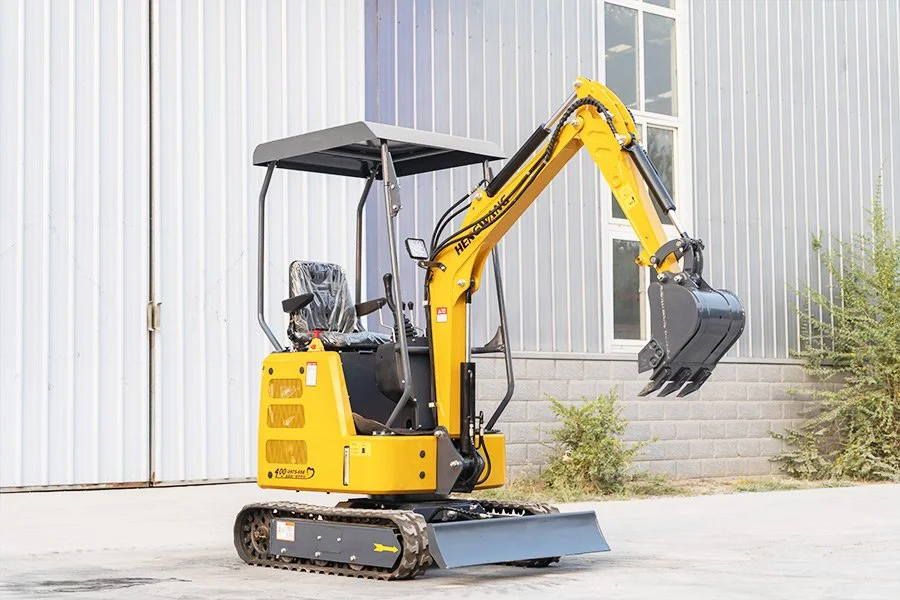
- Load-Sensing Piston Pumps: Found in high-end models like the Hengwang HW-12, these systems offer smoother control and better fuel efficiency by only delivering flow when demanded by the pilot controls.
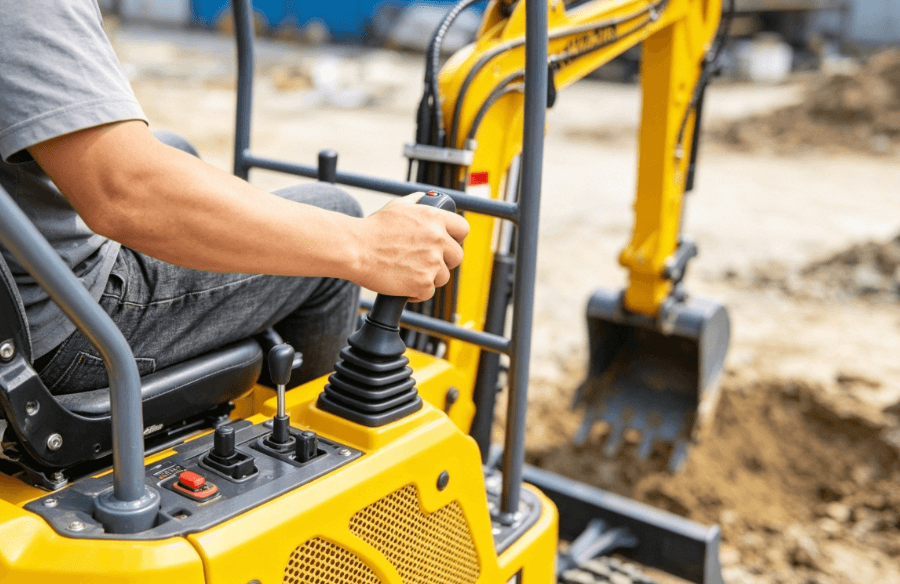
3. Pilot Controls vs. Mechanical Levers
Mechanical linkages are cheaper to manufacture but lead to operator fatigue. Hydraulic pilot controls (joysticks) improve precision and are now the industry standard for professional-grade wholesale units.
Case Study: The HW-12 Mini Excavator Benchmark
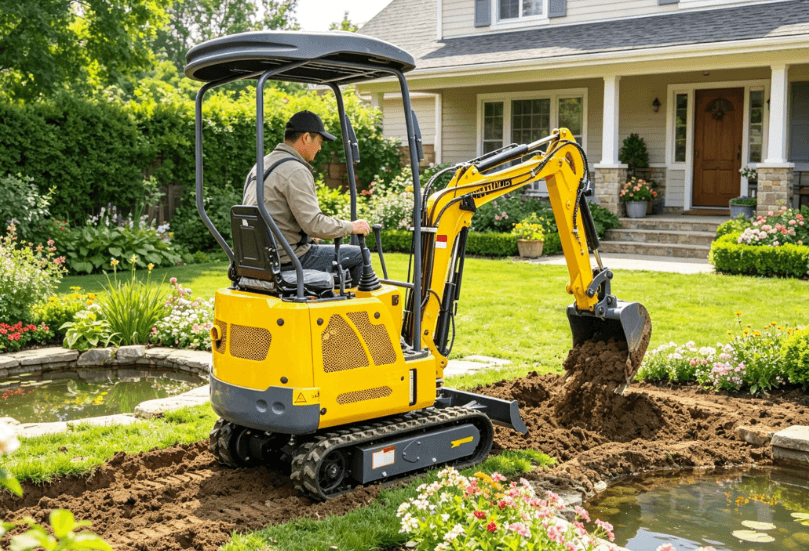
The HW-12 Mini Excavator serves as a strategic reference point for the 1-ton to 1.2-ton class, which is the highest-volume segment in the wholesale market.
Engineered for tight-access residential projects and utility work, the HW-12 balances structural durability with a compact footprint. Its design reflects the current “prosumer” and professional rental trend:
- Telescopic Tracks: A critical feature for stability. The ability to retract tracks to under 800mm allows the machine to pass through standard garden gates, while expanding them provides a stable platform for digging.
- Swing Boom Capability: Unlike rigid-frame budget models, the HW-12 incorporates a boom swing. This allows the operator to dig parallel to walls or foundations—a non-negotiable requirement for modern landscaping and trenching.
- Operating Weight: At approximately 1,200kg, it provides sufficient breakout force without requiring a heavy-duty CDL-grade trailer for transport, lowering the “logistics cost” component of the wholesale value proposition.
Comparative Analysis: Price vs. Performance Tiers
| Feature | Entry-Level Wholesale Unit | Professional Grade (e.g., HW-12) |
| Price Range (FOB) | $2,400 – $3,800 | $5,500 – $8,500 |
| Engine Type | Single-Cylinder (Air Cooled) | Multi-Cylinder (Water Cooled/Tier 4) |
| Control System | Mechanical Levers | Hydraulic Pilot Joysticks |
| Chassis | Fixed Width | Retractable/Telescopic |
| Auxiliary Hydraulics | Optional/Limited | Standard (for Augers/Breakers) |
| Expected Lifespan | 500 – 800 Hours | 2,000+ Hours |
The Hidden Logistics of Sourcing from China
When calculating your wholesale mini excavator price, the FOB (Free on Board) price is only the starting point. International B2B buyers must account for the “Landed Cost.”
- Container Optimization: A 20ft container typically holds 6 units of a 1-ton excavator, while a 40ft HQ container can hold 12–15 units. Ordering in these increments significantly reduces the per-unit shipping cost.
- Customs and Tariffs: For U.S. buyers, Section 301 tariffs may apply. It is essential to work with a manufacturer that provides correct HTS codes (Heading 8429) to avoid overpayment of duties.
- Assembly and PDI (Pre-Delivery Inspection): Wholesale units often arrive with the ROPS (Roll-Over Protective Structure) or canopy disassembled to maximize container space. Factor in 2–4 man-hours per machine for final assembly and hydraulic fluid checks upon arrival.
Quality Assurance in Mass Production
To maintain a competitive wholesale price without sacrificing integrity, top-tier manufacturers utilize automated fabrication processes.
- Robotic Welding: Ensures deep penetration and consistent beads on the boom and arm, which are the highest-stress points of the machine.
- Shot Blasting & Powder Coating: Standard liquid paint chips easily in construction environments. Powder coating provides the UV and corrosion resistance necessary for equipment that will be stored outdoors.
- Load Testing: Reputable factories subject a percentage of every batch to a 2-hour continuous cycle test to check for hydraulic leaks or thermal issues before crating.
Procurement Strategy: How to Request a Quote (RFQ)
To get an accurate and professional response from a manufacturer, your RFQ should be specific. Avoid asking simply “What is your best price?” Instead, define your technical requirements:
- Required Certifications: Specify CE for Europe or EPA for North America.
- Hydraulic Attachments: Do you need a thumb clip, auger, or hydraulic breaker? Bundling these at the factory level is significantly cheaper than sourcing them locally.
- After-Sales Support: Inquire about the “Wear Parts Package.” A standard wholesale agreement should include a kit of filters, seals, and specialized tools for the first 500 hours of service.
Conclusion
The wholesale mini excavator price is a reflection of a manufacturer’s engineering choices. While sub-$3,000 machines exist, they are often ill-suited for the rigors of professional construction or the legal requirements of regulated markets.
By focusing on models like the HW-12, which offer a balance of Tier 4 compliance, pilot controls, and versatile chassis options, wholesalers can ensure a higher resale value and lower warranty claims. True value in the machinery sector is found at the intersection of low entry costs and high mechanical uptime.
FAQ
Q: What is the typical MOQ for wholesale pricing?
A:Most Chinese manufacturers offer wholesale tiered pricing starting at 3–5 units. However, to see significant savings on sea freight, a full 20ft container (approx. 6 units) is the recommended minimum.
Q: How do I ensure the engine is genuinely EPA or Stage V compliant?
A:Request the EPA/CE certificate and the engine’s family name. Cross-reference this on the official EPA database. Reputable manufacturers like Hengwang provide this documentation during the RFQ stage.
Q: Can I customize the branding (OEM) on wholesale orders?
A:Yes. For orders exceeding 5–10 units, most manufacturers allow custom colors and logo placement. This is a standard practice for regional distributors looking to build their own brand presence.
Q: What are the payment terms for international machinery orders?
A:The industry standard is usually T/T (Telegraphic Transfer): 30% deposit to start production and 70% balance payment against the Bill of Lading (B/L) or before shipment.
Reference Source
- Association of Equipment Manufacturers (AEM): Trends in Compact Construction Equipment.
https://www.aem.org/ - ISO 9001:2015: Quality Management Systems for Heavy Machinery Manufacturing.
https://www.iso.org/standard/62085.html - U.S. Environmental Protection Agency (EPA): Nonroad Compression-Ignition Engines: Exhaust Emission Standards.
https://www.epa.gov/ - European Commission: Machinery Directive 2006/42/EC.
https://commission.europa.eu/index_en