Selecting the right bulldozer transmission involves more than choosing between brands. It is a fundamental engineering decision that dictates a machine’s cycle times, fuel efficiency, and long-term maintenance costs. For project managers and fleet owners, the “Powershift vs. Hydrostatic” debate centers on how power is transferred from the engine to the tracks under varying loads.
Modern earthmoving equipment has evolved far beyond manual gearboxes. Today, the choice between a mechanical-based Powershift system and a fluid-driven Hydrostatic drive determines whether a machine is a “bulk pusher” or a “precision grader.”
How Bulldozer Transmission Types Dictate Performance
The transmission serves as the mediator between engine torque and ground engagement. In the heavy equipment sector, two architectures dominate the market. Each handles the physical stress of dozing—pushing multi-ton loads while maintaining traction—through different mechanical philosophies.
1. Powershift Transmissions (Mechanical-Hydraulic Hybrid)
Powershift systems utilize a combination of a torque converter and planetary gear sets. The torque converter acts as a fluid coupling, allowing the engine to continue running even when the bulldozer is stationary or under extreme load.
When an operator shifts gears, hydraulic clutches engage the specific gear sets without interrupting power flow. This design is the industry standard for high-horsepower, heavy-duty applications. It excels in long-distance pushing and aggressive ripping where raw drawbar pull is the primary requirement.
2. Hydrostatic Drive Systems (Full Hydraulic)
Hydrostatic transmissions replace gears and clutches with a closed-loop hydraulic system. A variable-displacement pump is driven by the engine, which sends pressurized oil to hydraulic motors at each track.
Because there are no fixed gear ratios, the speed and torque are infinitely variable. This provides the operator with seamless control, allowing for “power turns” where one track moves faster than the other, maintaining full power through a curve.
Technical Comparison: Performance and Efficiency
| Feature | Powershift Transmission | Hydrostatic Drive |
| Power Delivery | Stepped (Discrete Gears) | Infinitely Variable |
| Control Precision | Moderate (Relies on Decelerator) | High (Fine speed adjustments) |
| Maneuverability | Limited (Pivot turns) | Superior (Counter-rotation) |
| Best Application | Heavy production, Mining, Ripping | Grading, Residential, Forestry |
| Mechanical Complexity | High (Gears, Clutches, Shafts) | Moderate (Pumps, Hoses, Motors) |
| Efficiency at High Speed | High (Direct mechanical link) | Lower (Hydraulic heat loss) |
Why Application Suitability Defines Your ROI
The decision between these bulldozer transmission types depends entirely on the duty cycle of your job site. A mismatch between transmission type and application leads to premature component wear and excessive fuel burn.
The Case for Powershift in Heavy Production
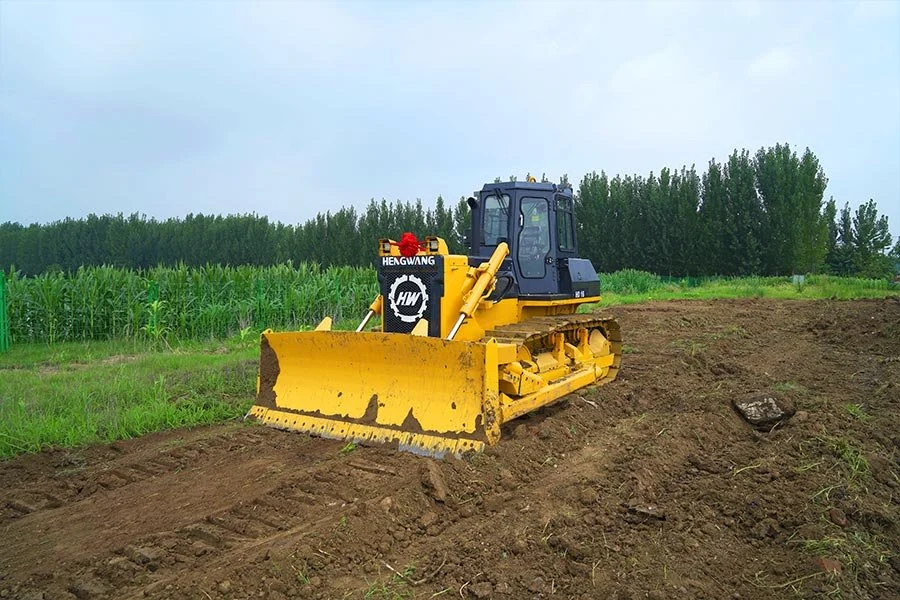
In large-scale operations, such as those utilizing Hengwang SD32 series bulldozers, Powershift is often preferred. When pushing massive piles of overburden or working in rocky terrain, the mechanical link of a Powershift system provides higher thermal stability.
These machines are engineered for straight-line power. The torque converter provides a “cushion” against shock loads when the blade hits buried obstacles, protecting the engine and drivetrain from catastrophic failure.
The Case for Hydrostatic in Precision Work
If your project involves finish grading, slope work, or navigating tight residential corridors, hydrostatic is the superior choice. The ability to counter-rotate the tracks—turning the machine within its own footprint—is a game-changer for productivity in confined spaces.
Hydrostatic machines also offer “dynamic braking.” As soon as the operator lets off the travel joystick, the hydraulic pressure stabilizes, naturally slowing the machine. This reduces brake wear and provides safer operation on steep inclines.
Operational Costs: Maintenance and Fuel Considerations
Total Cost of Ownership (TCO) is where the two technologies diverge most sharply.
Maintenance Logic:
- Powershift: Requires regular transmission fluid changes and monitoring of clutch pack wear. While the components are heavy and expensive, they are generally serviceable by most heavy equipment mechanics.
- Hydrostatic: Maintenance focuses on oil cleanliness. Contamination is the enemy of hydraulic pumps. While there are fewer mechanical parts to break, a failure in the high-pressure pump system often requires specialized diagnostic tools and clean-room repairs.
Fuel Economy:
Hydrostatic drives are generally more fuel-efficient in “part-load” scenarios because the engine can run at a constant, optimized RPM while the pumps adjust the speed. However, at maximum speed and full load, the mechanical efficiency of a Powershift system often wins out, as hydraulic systems generate heat which represents lost energy.
Selecting the Right Drive for Your Fleet
When evaluating your next acquisition, use this three-step framework:
- Analyze the Material: Are you pushing loose sand, heavy clay, or shot rock? Heavier materials favor the robust mechanical link of Powershift.
- Evaluate the Space: Will the machine be working in wide-open fields or between building foundations? Tight spaces demand the maneuverability of a hydrostatic drive.
- Operator Skill Level: Hydrostatic machines are often easier for newer operators to master due to simplified controls. Powershift machines require more active management of gear selection and engine speed to maintain peak efficiency.
For versatile fleets, many contractors find that a mix of both types provides the best coverage. High-capacity models, like the SD22 or SD32, handle the primary earthmoving, while smaller hydrostatic units follow behind for final site dressing and detail work.
FAQ
Which bulldozer transmission type is better for steep slopes?
Hydrostatic drives are typically preferred for slope work because they provide constant power to both tracks and offer superior speed control. The inherent dynamic braking of the hydraulic system prevents the machine from “freewheeling” down a grade.
Can a Powershift bulldozer counter-rotate?
Generally, no. Most Powershift bulldozers utilize steering clutches and brakes, allowing for pivot turns (stopping one track while the other moves). Hydrostatic machines can drive tracks in opposite directions simultaneously for a true zero-turn radius.
What is a Torque Divider in a Powershift system?
A torque divider is a specialized component found in high-end Powershift bulldozers (like Caterpillar or high-spec Hengwang models). It splits engine power—sending 70% through a torque converter and 30% through a direct mechanical shaft—to balance heavy pushing power with operational efficiency.
Is hydrostatic more expensive to repair than Powershift?
Component for component, a high-pressure hydraulic pump can be more expensive than a gear set. However, hydrostatic systems have fewer moving parts overall. The key to low-cost hydrostatic operation is aggressive filtration and oil sampling.
Reference Sources
- ISO 6165:2022 – Earth-moving machinery — Basic types — Identification and vocabulary.
- SAE J1059 – Speed Control Categories for Construction and Industrial Machinery.
- Construction Equipment Association (CEA) – Technical reports on Drivetrain Efficiency in Crawler Dozers.
- Hengwang Group Technical Documentation – Operational Guide for SD Series Crawler Bulldozers.