What is a bulldozer, and how does it actually function? A bulldozer is a heavy-duty tracked machine engineered to move massive quantities of earth. It operates by converting diesel engine torque into powerful tractive force. This force is transferred through a continuous track system to push a front-mounted heavy steel blade.
These industrial machines prioritize low-speed pushing power over transportation speed. The continuous tracks distribute the equipment’s massive weight, drastically lowering ground pressure. This mechanism allows the heavy machine to operate on unstable, rocky, or muddy terrain without sinking.
A sophisticated hydraulic system enables precise control of the front blade and rear attachments. Operators can lift, tilt, and angle the blade to grade surfaces accurately. Understanding these mechanical principles is essential for professionals in heavy civil engineering and mining.
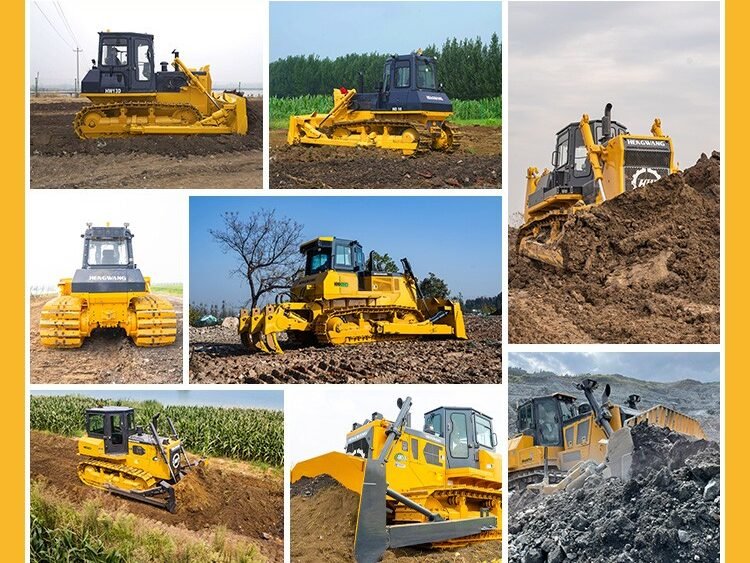
What Are the Core Mechanical Principles of a Bulldozer?
The fundamental physics of a crawler tractor rely on traction and mechanical advantage. The diesel engine produces continuous low-RPM torque. A torque converter then multiplies this mechanical force before sending it to the transmission system.
This specific drivetrain setup prevents the engine from stalling under sudden heavy loads. It allows the machine to push against solid rock or compacted soil continuously. The transmission then sends this rotational force to the final drives.
The final drives utilize planetary gear sets located near the track sprockets. These gears reduce rotational speed while vastly increasing the final output torque. The sprockets then pull the continuous track chain, moving the massive machine forward.
Steering a crawler tractor differs completely from wheeled vehicles. Operators use advanced steering clutches and brakes to slow one track down[1]. This action causes the machine to pivot around the slower track, enabling highly maneuverable tight turns.
Anatomy of a Dozer: Engineering the Drivetrain and Implements
Heavy earthmoving machinery requires highly durable and specialized components. Every structural part is built to withstand extreme vibration and abrasive environments. Standard dimensional specifications and definitions are outlined in engineering standards like SAE J729.
Here are the primary structural components of a crawler tractor:
- Diesel Engine: High-displacement turbocharged engines provide the baseline horsepower and torque.
- Torque Converter: A hydrodynamic fluid coupling that links the engine to the transmission securely.
- Undercarriage: Consists of track chains, idlers, rollers, steel bushings, and driving sprockets.
- Front Implements: The heavy steel blade moves material, while hydraulic cylinders provide the pushing force.
- Rear Attachments: A steel ripper shank fractures hardpan or frozen ground before grading.
The operator cabin is also heavily reinforced for industrial safety. It features Roll-Over Protective Structures (ROPS) and Falling-Object Protective Structures (FOPS). These heavy steel frames protect operators in hazardous mining or forestry environments.
How Track Design Affects Ground Pressure and Traction
Ground pressure defines a machine’s ability to navigate different soil densities. It is calculated by dividing the machine’s operating weight by the track contact area. Track shoe width drastically changes this critical engineering metric.
Standard tracks utilize narrower steel shoes designed for hard, rocky surfaces. They exert higher ground pressure, often exceeding 10 PSI. The concentrated weight helps the track grousers penetrate compacted soil for maximum grip. Using standard tracks in deep mud will cause the machine to sink rapidly.
Low Ground Pressure (LGP) tracks feature exceptionally wide track shoes. They spread the vehicle’s weight, dropping the ground pressure to as low as 4 or 5 PSI. LGP setups create a flotation effect, which is mandatory for wetland operations and soft soil grading. According to ISO 6165 terminology, this continuous tracked movement provides essential earthmoving stability.
Bulldozer Blade Types and Material Handling Capabilities
Different geological materials require specific blade geometries for efficient handling. The curve and shape of the blade dictate how the soil rolls forward. Efficient rolling reduces pushing resistance, lowers fuel consumption, and limits undercarriage wear.
| Blade Type | Shape Characteristic | Primary Application |
| S-Blade (Straight) | Flat face, no side wings | Fine finish grading, backfilling, and stumping |
| U-Blade (Universal) | Deep curvature, large wings | Carrying loose materials over long distances |
| SU-Blade (Semi-U) | Slight curve, short wings | Heavy rock pushing and general earthmoving |
| Angle Blade | Straight face, pivots laterally | Side-casting material and shaping roadbeds |
Proper blade selection determines the efficiency of standard earthmoving cycles. Pushing dead weight over long distances requires more fuel and causes unnecessary mechanical strain. A well-matched blade rolls the material continuously, optimizing the machine’s tractive effort.
The Role of Hydraulics in Precision Earthmoving
Early crawler tractors used slow, cable-operated blade lifting systems. Modern heavy machines rely entirely on high-pressure, closed-center hydraulic systems. Variable displacement piston pumps provide the exact hydraulic fluid flow required by the load.
These on-demand hydraulic systems reduce the continuous parasitic load on the diesel engine. Hydraulic cylinders convert this pressurized fluid into linear mechanical force. They allow the operator to adjust the blade’s lift, pitch, and tilt with immense power.
Hydraulic relief valves protect the internal system from catastrophic pressure spikes. If the blade strikes an immovable boulder, internal pressure increases rapidly. The relief valve opens instantly, bypassing fluid to prevent blown heavy-duty hoses or cylinder damage.
Many modern hydraulic valves integrate directly with 3D GPS grading systems. This technology automates the blade movement based on digital engineering site plans. The operator simply steers while the computer maintains precise subbase grade elevations.
Matching Machine Specifications to Industrial Applications
Selecting an appropriate crawler tractor requires analyzing the specific operating environment. Civil engineers must evaluate engine horsepower, operating weight, and volumetric blade capacity. The project scope dictates the necessary heavy machinery class.
For highway construction and large-scale multi-building developments, balanced mid-sized machines perform best. Equipment lines like the HW16D or HW22D dozers are engineered for mid-to-large scale road building. They handle bulk earthmoving efficiently while maintaining maneuverability on active construction sites.
Wetland projects and coastal reclamation require specialized undercarriage configurations. The HW16DS model, for instance, features specialized wetland LGP configurations. These extended track setups prevent costly equipment recovery scenarios in saturated marshlands.
In the mining industry, continuous operation dictates heavy equipment design. Earthmoving machines run constantly in highly abrasive, high-impact environments. Reinforced semi-U blades, severe-duty undercarriages, and advanced air filtration systems are mandatory for continuous site productivity.
Frequently Asked Questions (FAQ)
What is the primary function of a bulldozer?
A bulldozer is designed primarily to push large quantities of soil, rubble, or rock. It is utilized heavily for land clearing, rough grading, and bulk earthmoving. The machine relies on raw pushing power rather than lifting or hauling capacity.
How does a torque converter function in a crawler tractor?
A torque converter acts as a hydrodynamic fluid coupling between the engine and transmission. It multiplies engine torque at very low ground speeds. This critical component prevents the engine from stalling when the blade impacts immovable objects.
Why do earthmoving machines use tracks instead of wheels?
Continuous steel tracks distribute the machine’s massive weight over a much larger surface area. This lowers the ground pressure and prevents the heavy equipment from sinking. Tracks also provide superior traction and grip in loose, muddy, or uneven terrain.
What role does the hydraulic system play in grading?
The hydraulic system powers the heavy steel cylinders attached to the blade and ripper. It converts pressurized fluid into precise mechanical force. This allows operators to accurately adjust the blade’s pitch, tilt, and height during finish grading operations.
Reference Sources
- SAE J729: Dozer Nomenclature and Specifications. Society of Automotive Engineers.
- ISO 6165: Earth-moving machinery — Basic types — Identification and terms and definitions. International Organization for Standardization.
- Heavy Machinery Engineering Principles & Earthmoving Performance Standards.