The global heavy equipment market has undergone a seismic shift over the last decade, with China emerging not just as a high-volume producer, but as a hub for engineering innovation. For overseas dealers, the challenge is no longer finding a manufacturer, but identifying a partner whose production standards, supply chain stability, and after-sales infrastructure align with local market demands.
Whether you are catering to high-intensity mining operations in Australia or urban construction projects in Southeast Asia, selecting the right wheel loader manufacturer in China requires a deep dive into technical integration and manufacturing philosophy.
What Defines a Top-Tier Wheel Loader Manufacturer in China?
In the current industrial landscape, “quality” is a multi-dimensional metric. When evaluating a wheel loader manufacturer in China, technical experts and procurement consultants look beyond the sticker price. They focus on the synergy between the powertrain, hydraulic efficiency, and structural durability.
A Tier 1 manufacturer distinguishes itself through:
- Component Provenance: Integration of globally recognized systems, such as Cummins or Weichai engines, ZF transmissions, and Kawasaki hydraulics, which ensure parts availability for the end-user.
- Structural Integrity: Use of robotic welding for booms and frames to ensure consistent penetration and stress relief, preventing fatigue cracks in high-torque applications.
- Emission Compliance: Capability to produce machines that meet EPA Tier 4 Final or EU Stage V standards for regulated markets, alongside Stage II/III for emerging markets.
Comparing the “Big Three” vs. Specialized Manufacturers
The Chinese market is bifurcated into massive conglomerates and specialized agile manufacturers. Understanding which one fits your dealership’s business model is critical.
1. The Industrial Giants (XCMG, LiuGong, SDLG)
These manufacturers operate on a scale that provides immense “Topical Authority” in the construction sector. Their strengths lie in R&D budgets and global brand recognition. For a dealer, partnering with these firms offers a sense of security and a pre-established parts network. However, the MOQ (Minimum Order Quantity) and dealer requirements are often significantly higher.
2. Specialized Manufacturers and OEM Partners
Smaller, specialized factories often offer greater flexibility in customization. For dealers looking to fill a specific niche—such as ultra-compact loaders for greenhouse work or specialized attachments for the timber industry—these manufacturers provide a more collaborative engineering relationship. They are often more willing to adjust hydraulic flow rates or cooling package configurations based on specific regional climate data provided by the dealer.
Technical Deep-Dive: Assessing Machine Performance
To provide real value to your customers, you must evaluate the machine’s “Work Cycle Efficiency.” A high-performing wheel loader is measured by its breakout force and its cycle time (lifting, dumping, and lowering).
| Technical Metric | Industrial Standard (Tier 1) | Importance for Dealers |
| Breakout Force | 160kN – 200kN (for 5-ton class) | Determines the ability to handle tough, compacted materials. |
| Transmission Type | Planetary or Countershaft | Affects shifting smoothness and long-term maintenance costs. |
| Hydraulic System | Load-sensing (Variable Displacement) | Reduces fuel consumption by providing power only when needed. |
| Articulation Angle | 35° to 40° | Critical for maneuverability in tight job sites. |
The Role of Ancillary Components in Manufacturing Excellence
While the engine and hydraulics are the “heart” of the machine, the longevity of a wheel loader also depends on the “smaller” details of the assembly process. In the manufacturing of modern quiet-cab designs, for instance, high-performance bonding materials are essential.
For dealers inspecting a factory, pay attention to how the cabin interiors and insulation are mounted. Leading manufacturers are increasingly moving away from traditional mechanical fasteners for non-structural components to reduce Vibration, Noise, and Harshness (NVH).
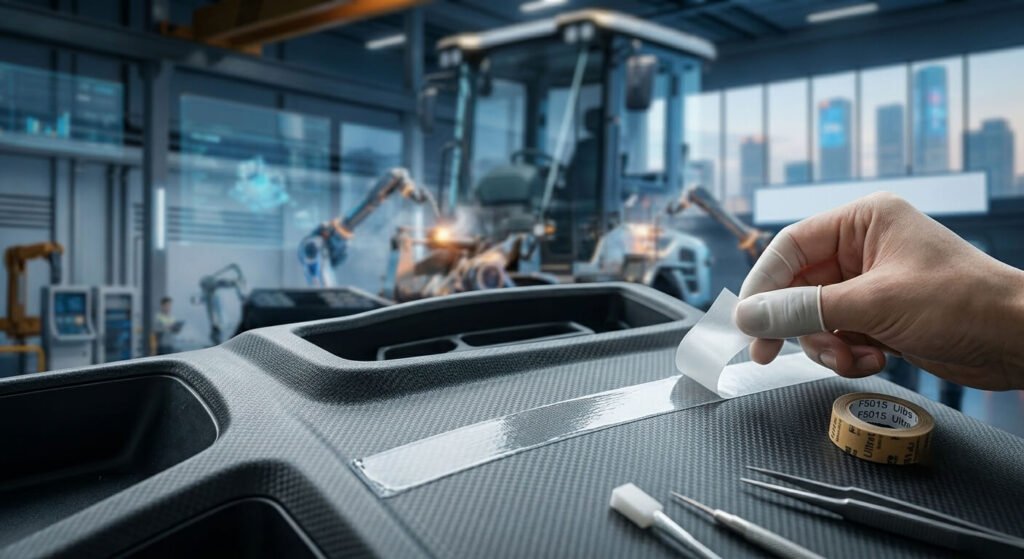
Advanced solutions, such as the F5015 Ultra Viscosity Tissue Double-Sided Tape, are often utilized in the assembly of dashboard consoles, sound-deadening foams, and weather-stripping. The use of high-tack, temperature-resistant adhesives ensures that interior trim remains intact even when the machine is operating in extreme temperatures (from -20°C to +50°C), a common pain point for operators in desert or arctic environments. This attention to detail in the assembly phase is a strong indicator of a manufacturer’s commitment to long-term reliability.
Evaluating Dealer Support and the “After-Market Ecosystem”
For an overseas dealer, the relationship with a wheel loader manufacturer in China truly begins after the machine leaves the port. Your profitability is tied to your ability to keep your customers’ machines running.
1. Spare Parts Logistics:
Does the manufacturer maintain regional parts hubs? A machine down for three weeks waiting for a $50 sensor from Shanghai is a reputational disaster for a dealer. Ensure the manufacturer has a digital parts catalog and a streamlined RFQ process for emergency air-freight.
2. Technical Training:
A reputable manufacturer should provide comprehensive service manuals (in the local language) and video-based training for your technicians. Some now offer remote diagnostic support, allowing factory engineers in China to troubleshoot hydraulic pressures or electrical faults via telematics.
3. Warranty Terms:
Look for “12 months or 2,000 hours” as a baseline. However, the process of claiming the warranty is more important than the length. Is there a clear protocol for labor reimbursement, or does the manufacturer only provide the replacement part?
Strategic Sourcing: The RFQ Workflow for Dealers
When moving toward a transactional phase, follow this structured workflow to mitigate risk:
- Initial Technical Audit: Request the “Factory Inspection Report” and ISO 9001 certifications.
- Sample Testing: Import a single unit for 500 hours of “real-world” stress testing in your local soil conditions before committing to a container-load.
- Customization Discussion: Negotiate specific regional requirements (e.g., extra-capacity air pre-filters for dusty environments or specific tire brands).
- Compliance Verification: Ensure all ROPS/FOPS (Roll-Over/Falling Object Protective Structures) certifications are authenticated and meet your local safety regulations (OSHA, CE, etc.).
Final Considerations for Overseas Dealers
Choosing the right partner in the Chinese heavy equipment sector is an exercise in balancing cost with technical support. While the “Big Three” offer brand power, many emerging manufacturers provide superior technological flexibility and competitive lead times.
Focus on manufacturers that demonstrate an understanding of the total cost of ownership (TCO). A machine that integrates high-quality assembly materials—ranging from the steel in the bucket to the ultra-viscosity tapes in the cabin—will ultimately yield fewer warranty claims and higher customer loyalty for your dealership.
FAQ
Q: What is the typical MOQ for a wheel loader manufacturer in China?
A: For most Tier 1 manufacturers, the MOQ typically starts at 1 to 3 units for initial dealer trials. However, to optimize shipping costs (fitting into 40HC containers), orders of 2 units are common for 3-ton models, while 5-ton models often ship as single units or via RORO (Roll-on/Roll-off) vessels.
Q: How do I verify if a manufacturer’s CE or Tier 4 certification is legitimate?
A: Always ask for the certificate number and the name of the certifying body (e.g., TÜV SÜD or SGS). You can verify these directly on the agency’s website. Furthermore, check the engine’s serial number with the engine manufacturer (Cummins, Yanmar, etc.) to confirm it meets the stated emission standards.
Q: Can Chinese wheel loaders be customized for specific attachments?
A: Yes. Most manufacturers offer a “Quick Hitch” system. You can request specific hydraulic auxiliary lines (third-function valves) to support attachments like grapples, 4-in-1 buckets, or snow blowers.
Q: What are the average lead times for custom-configured loaders?
A: Standard models usually have a lead time of 20–30 days. Custom configurations involving specific engines or specialized hydraulic setups can extend this to 45–60 days, excluding shipping time.
Reference Sources
- Off-Highway Research: Global Construction Equipment Market Trends
- ISO Standards: ISO 9241-1: Earth-moving machinery — Safety
- Construction Equipment Association (CEA): Technical Guides on Emission Standards
- SGS Group: Industrial Manufacturing Inspection Services