Mining operations are defined by the sheer volume of material moved and the harshness of the environment. In this ecosystem, the bulldozer serves as the primary force for site preparation, material handling, and environmental restoration. Unlike standard construction projects, mining requires machines that can withstand 24/7 duty cycles and extreme abrasive conditions.
Understanding the specific applications of bulldozers in mining is essential for site managers looking to optimize “cost-per-ton” metrics. From the initial stripping of topsoil to the final stages of land reclamation, these tracked powerhouses provide the tractive effort and stability that wheeled loaders often cannot match.
1. Overburden Removal and Surface Stripping
In open-pit mining, the first objective is reaching the ore body. This involves removing the “overburden”—the layers of soil and rock covering the mineral deposit. Bulldozers are the preferred tool for this stage due to their high drawbar pull.
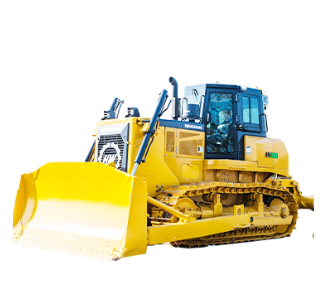
Large-scale dozers, typically those in the 320HP+ range like the heavy-duty HW32 series, are used to push vast quantities of loose material over the edge of a highwall or into a designated spoil pile. Their ability to operate on uneven, soft, or rocky terrain ensures that the site remains productive even before haul roads are fully established.
2. High-Capacity Stockpile Management
Once material is extracted, it is often moved to stockpiles before processing or transport. Bulldozers play a critical role in maintaining these piles. By utilizing specialized “U-blades” (Universal blades) with large wings, a dozer can push significantly more volume than a standard straight blade.
Effective stockpile management involves:
- Layering: Spreading material evenly to prevent spontaneous combustion in coal mining.
- Reclamation Feeding: Pushing ore into underground reclaim hoppers.
- Compaction: Using the machine’s weight to stabilize the pile, reducing oxygen ingress and preventing erosion.
3. Haul Road Construction and Maintenance
The efficiency of a mine is often limited by the speed of its haul trucks. If a haul road is uneven or poorly graded, truck cycle times increase, and tire wear accelerates—a massive operational cost.
Bulldozers are used to cut the initial path for these roads, ensuring proper drainage and grade. While motor graders handle the fine finishing, dozers do the heavy lifting: removing boulders, filling large depressions, and creating the safety berms (edge barriers) required by MSHA and international safety standards.
4. Technical Comparison: Mining Blade Configurations
Selecting the right attachment is as important as the machine itself. In mining, the choice of blade dictates the production rate.
| Blade Type | Best Application | Material Type |
| Straight (S-Blade) | Stripping & Grading | Hard, compacted soil |
| Universal (U-Blade) | Stockpiling & Long Pushes | Loose, low-density material |
| Semi-U (SU-Blade) | General Mining / Production | Mixed rock and dirt |
| Angle Blade | Road Side-casting | Soft to medium soil |
5. Ripping Operations in Hard Rock
When the ground is too hard for a blade to penetrate but does not yet justify the cost of “drill and blast” operations, ripping is the solution. Most mining-spec dozers are equipped with a rear-mounted multi-shank or single-shank ripper.
The ripper uses the machine’s weight and hydraulic down-pressure to tear through rock layers. Single-shank rippers are generally preferred in mining for deep penetration into tough materials like limestone or shale. This process “pre-conditions” the ground, making it easier for the blade to move the material in the next pass.
6. Environmental Reclamation and Restoration
Modern mining is governed by strict environmental regulations requiring the land to be returned to its natural state. Bulldozers are the primary tools for “re-contouring” the landscape.
After the ore is depleted, dozers move the original overburden back into the pit or across the site to mimic original topographical features. They spread topsoil and create the necessary seedbeds for revegetation. Because of their low ground pressure relative to their size, dozers can traverse these sensitive, newly placed layers without causing excessive compaction that would hinder plant growth.
7. Critical Engineering Specifications for Mining
When evaluating bulldozers for mining environments, engineers focus on durability over pure speed. High-drive undercarriage designs, often seen in premium crawler models, isolate the final drives from ground-induced shocks, which is vital in rocky mining sectors.
Key technical factors include:
- Undercarriage Life: Mining dozers require “Salt” (Sealed and Lubricated Tracks) to reduce internal pin and bushing wear.
- Engine Cooling: Large-capacity radiators and reversible fans are necessary to handle the high dust concentrations and ambient heat of open pits.
- Hydraulic Efficiency: Modern machines utilize load-sensing hydraulics to provide power only when needed, reducing fuel consumption during high-production shifts.
8. Safety and Remote Operations
Mining is inherently hazardous. Steep grades and the risk of landslides make dozer operation high-risk. Industry leaders are increasingly adopting remote-control or semi-autonomous dozer systems. These allow operators to control the machine from a safe distance during high-wall work or when clearing unstable spoil heaps, significantly reducing the potential for workplace injuries.
FAQ
Q: Why are crawler bulldozers preferred over wheeled dozers in mining?
A: Crawler dozers offer superior traction and a lower center of gravity. In mining, where slopes are steep and the ground can be unstable or sharp-edged rock, tracks provide the “grip” and durability that tires cannot, preventing slippage and frequent tire failures.
Q: What is the average lifespan of a bulldozer in a mining environment?
A: A well-maintained mining dozer can last between 15,000 to 30,000 hours. However, this requires a strict “Mid-Life Rebuild” of the engine and powertrain, and the undercarriage is typically replaced every 3,000 to 5,000 hours depending on the abrasiveness of the material.
Q: How does horse-power (HP) affect mining productivity?
A: HP dictates the “pushing capacity.” For light utility work and road maintenance, 100-160HP is sufficient. For heavy production and overburden stripping, machines in the 220HP to 320HP+ range (such as the Hengwang HW series) are required to move the necessary volume to remain profitable.
Q: Can a bulldozer be used for primary extraction?
A: Yes, in “dozer mining” or “strip mining,” the dozer is the primary extraction tool. It pushes the ore directly to a conveyor or a loading point, bypassing the need for excavators in specific geological layouts.
Reference Sources
- ISO 6165:2022 – Earth-moving machinery — Basic types — Identification and vocabulary. ISO.org
- SME (Society for Mining, Metallurgy & Exploration) – Technical papers on Surface Mining Equipment selection and “Cost-per-ton” modeling. smenet.org
- Caterpillar Performance Handbook – The industry standard for estimating dozer production rates and material densities (Edition 49+).
- MSHA (Mine Safety and Health Administration) – Safety guidelines for surface haulage and mobile equipment operation. msha.gov