Understanding the Mechanics of Primary Fragmentation
In large-scale earthmoving and mining operations, the challenge often lies in penetrating consolidated rock or frozen ground that defies standard bucket excavation. While both bulldozers and excavators are staples on the job site, their methods of breaking material are fundamentally different.
The bulldozer ripper is a rear-mounted, claw-like device designed to utilize the machine’s massive weight and drawbar pull to fracture sub-surface materials. Conversely, excavator attachments, such as hydraulic hammers or ripper teeth, rely on high-pressure hydraulic circuits and localized prying forces.
Choosing the wrong tool doesn’t just slow down production. It leads to excessive undercarriage wear, hydraulic overheating, and increased fuel consumption per cubic meter of displaced material.
The Engineering of the Bulldozer Ripper: Power Through Traction
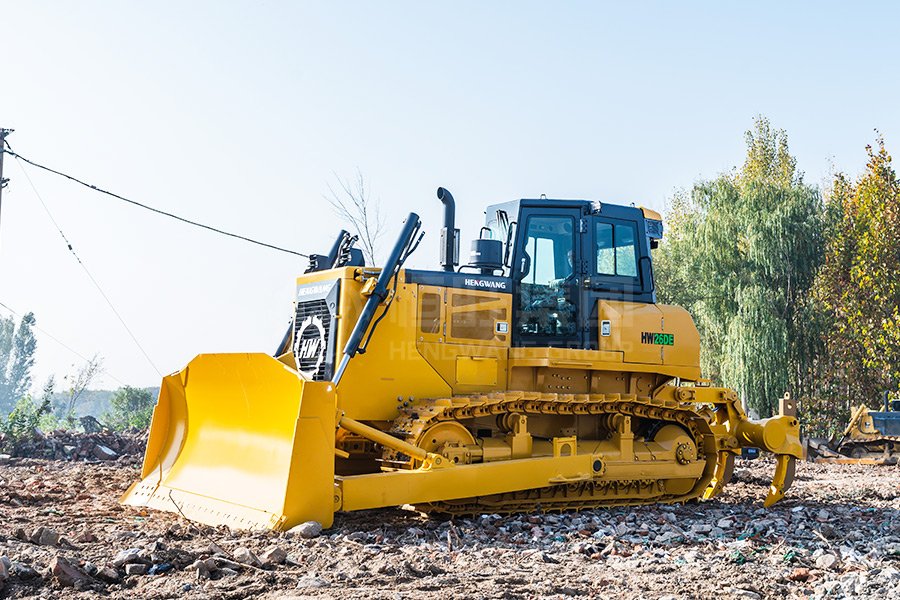
A bulldozer ripper operates on the principle of continuous force. Unlike an excavator that works from a static position, a bulldozer (such as the high-horsepower models found in the Hengwang bulldozer lineup) moves forward, dragging the ripper shank through the earth.
There are two primary configurations for these tools:
- Single-Shank (Giant) Rippers: These are engineered for deep penetration in heavy rock. The single point of contact focuses the entire machine’s downward pressure and tractive effort into one narrow area, allowing it to fracture high-density materials like limestone or weathered granite.
- Multi-Shank Rippers: Typically featuring three shanks, these are ideal for less abrasive materials, such as compacted clay, shale, or frozen soil. They prioritize volume and surface area over maximum depth.
The efficiency of a bulldozer ripper is dictated by the “parallelogram linkage” design. This mechanism ensures the ripper shank maintains a constant angle as it enters the ground, providing superior penetration compared to older radial designs.
Excavator Attachments: Precision and Versatility
While a dozer is a brute-force tool, an excavator is a precision instrument. Excavator attachments for breaking ground usually fall into three categories:
- Hydraulic Breakers (Hammers): These use high-frequency percussion to crack rock. They are the preferred choice for oversized boulders or reinforced concrete demolition where a dozer cannot gain traction.
- Excavator Ripper Teeth: A single, reinforced tooth that replaces the bucket. It uses the “prying” motion of the bucket cylinder to pop out rocks.
- Static Rippers: Similar to a dozer shank but limited by the machine’s weight.
The primary limitation of an excavator attachment is the duty cycle. Constant hammering or prying puts immense stress on the boom pins and bushings, whereas a dozer’s ripper distributes the load through the main frame and undercarriage.
Technical Performance Comparison
| Feature | Bulldozer Ripper | Excavator Attachment (Breaker/Ripper) |
| Primary Force | Drawbar Pull + Machine Weight | Hydraulic Pressure + Arm Leverage |
| Best For | Large-scale site prep, mining, long runs | Trenching, demolition, confined spaces |
| Material Hardness | Up to 60-80 MPa compressive strength | Can handle >100 MPa (with hammer) |
| Productivity | High (continuous motion) | Moderate (intermittent positioning) |
| Wear Focus | Ground engaging tools (GET) & Undercarriage | Hydraulic seals, pins, and bushings |
Soil and Rock Compatibility: When to Choose Which?
The decision often comes down to the Seismic Velocity of the rock—a measure of how fast sound waves travel through the material, which correlates to its “rippability.”
If the seismic velocity is below 2,000 meters per second (m/s), a bulldozer ripper is almost always the most cost-effective solution. It can process thousands of cubic yards per shift by “pre-ripping” the area before a scraper or loader moves in.
Once the velocity exceeds 2,500 m/s, the rock becomes too hard for a dozer to penetrate effectively. In these scenarios, an excavator equipped with a heavy-duty hydraulic hammer becomes necessary to “chip away” at the formation.
Operational Synergies in Modern Construction
In professional fleet management, these tools are rarely used in isolation. A common workflow involves a large bulldozer (like the Hengwang SD22 or SD32) performing the primary rip to fracture the upper layers of a site.
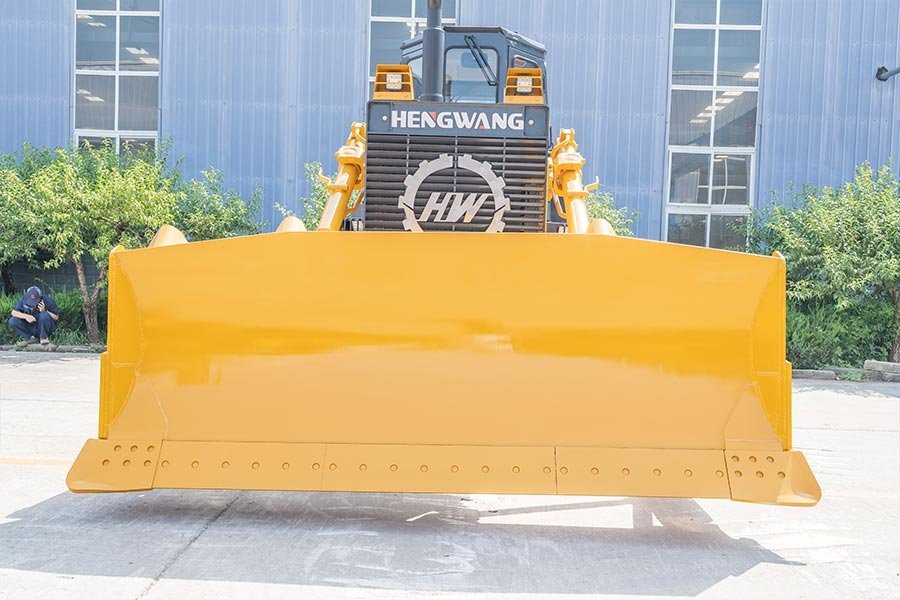
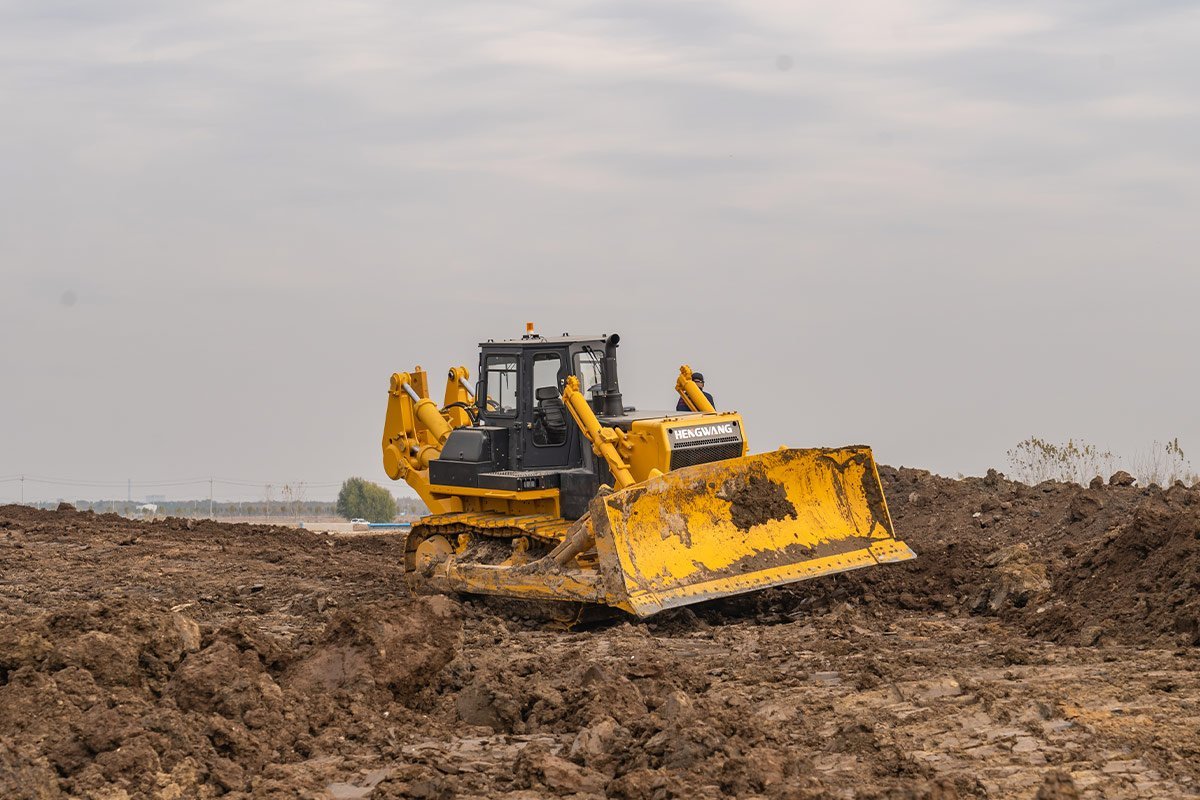
Once the dozer has loosened the bulk of the material, excavators move in to handle the “detail work”—trenching for utilities or clearing edges where a large dozer cannot safely maneuver. This hybrid approach maximizes the lifespan of both machines. The dozer handles the high-volume, high-wear tasks, while the excavator focuses on precision and vertical extraction.
Impact on Machine Longevity and Maintenance
Using a bulldozer ripper correctly requires an understanding of “shattering” versus “crushing.” Operators should avoid “spinning the tracks,” which occurs when the ripper hits a seam it cannot penetrate. This causes rapid heat buildup in the track shoes and bushings.
For excavator attachments, maintenance centers on the hydraulic system. Contamination is the leading cause of failure. When switching from a bucket to a hammer, the hydraulic fluid must be monitored for metal particles that could damage the pump.
Why Design Matters: The Hengwang Advantage
When evaluating machinery, the integration of the ripper into the machine’s chassis is critical. High-performance bulldozers utilize high-strength alloy steel for the ripper mounting plates to prevent frame cracking during extreme stress.
As noted in our comprehensive bulldozer guide, the balance between engine torque and operating weight is what determines “penetration power.” A machine that is too light will simply “ride up” on the ripper shank, while a machine with insufficient torque will stall.
Final Selection Criteria
To determine the right tool for your project, ask the following:
- What is the total volume of material? If >10,000 m³, a dozer ripper is more efficient.
- What is the depth of the cut? Excavators can reach deeper vertically, but dozers cover more horizontal ground.
- What is the material hardness? Use a Mohs scale or seismic test.
- Are there space constraints? Excavators are superior for urban sites or steep embankments.
FAQ
Q: Can a bulldozer ripper replace blasting?
A: In many cases, yes. Modern high-horsepower dozers can rip rock that previously required drilling and blasting, significantly reducing insurance costs and environmental impact.
Q: How often should ripper tips be replaced?
A: This depends entirely on the abrasiveness of the soil. In highly abrasive sandstone, tips may need replacement every 20-40 hours. In clay, they may last hundreds of hours. Always replace tips before they wear down to the shank to avoid expensive repairs.
Q: Is it better to use a single-shank or multi-shank ripper for frozen ground?
A: Multi-shank rippers are generally preferred for frost layers, as the frost is often brittle but not as dense as solid rock. The multiple shanks allow for wider coverage in a single pass.
Q: Does using a ripper increase fuel consumption significantly?
A: Yes. Ripping is one of the most power-intensive tasks a bulldozer performs. It is common to see fuel consumption increase by 20-30% during heavy ripping operations compared to standard dozing.
Reference Sources
- ISO 6746-1: Earth-moving machinery — Units for dimensions, symbols, and terminology.
- Caterpillar Performance Handbook: Methodologies for determining rippability based on seismic velocity.
- SAE J743: Undercarriage Wear and Tractive Effort Standards for Crawler Tractors.
- ASTM D1557: Standard Test Methods for Laboratory Compaction Characteristics of Soil.