The success of any civil engineering project, particularly in highway and urban infrastructure, depends entirely on the stability of the earth beneath the pavement. In the hierarchy of heavy equipment, the bulldozer remains the primary mover of the industry. Far from being a simple tool of brute force, bulldozer road construction involves sophisticated physics, hydraulic precision, and strategic site management to transform raw terrain into a viable transport corridor.
For project managers and lead engineers, the bulldozer is often the first machine on-site and the last to leave the subgrade phase. Its ability to provide massive tractive effort—the force generated between the tracks and the ground—allows it to perform tasks that motor graders and excavators cannot manage alone, specifically in the initial stages of mass earthmoving and slope stabilization.
The Fundamental Mechanics of Earthmoving in Road Infrastructure
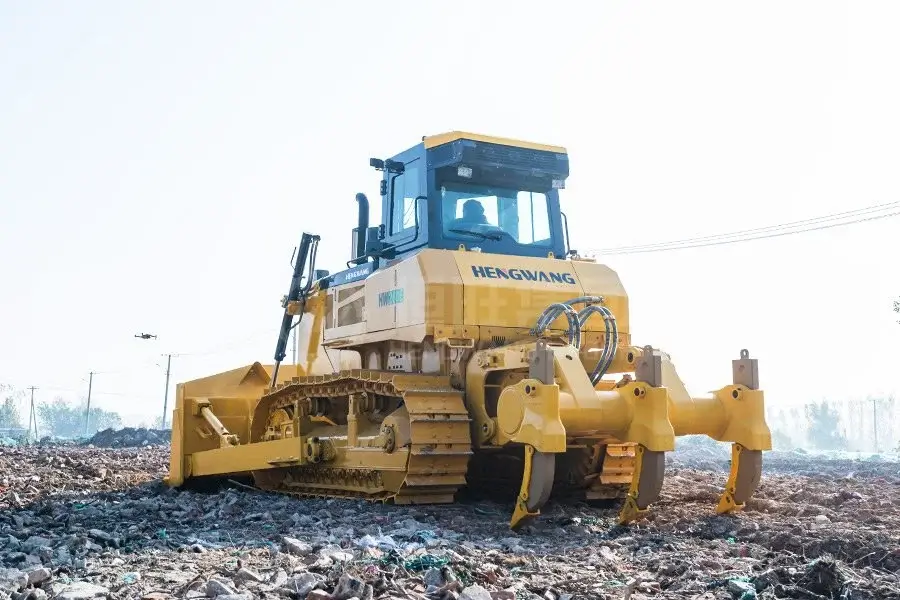
At its core, a bulldozer is a high-torque crawler tractor equipped with a substantial metal plate (blade). In road construction, the machine’s primary value lies in its low center of gravity and expansive track footprint. This design distributes weight over a large area, preventing the machine from sinking into soft soils while providing the “pushing power” necessary to relocate tons of material in a single pass.
The efficiency of road construction depends on the “cut and fill” process. Engineers design road profiles to minimize the transport of external materials. Bulldozers are used to “cut” high points of the terrain and “fill” the depressions. By maintaining a balanced earthwork budget, contractors reduce costs and environmental impact, utilizing the bulldozer’s ability to move material over short to medium distances (typically under 100 meters) more efficiently than any other vehicle.
Essential Phases of Bulldozer Application in Road Projects
The lifecycle of a road construction project involves several distinct stages where the bulldozer is the primary actor.
1. Site Clearing and Grubbing
Before the first layer of gravel is laid, the “right-of-way” must be cleared of organic matter. Bulldozers equipped with heavy-duty straight blades or specialized clearing rakes remove trees, boulders, and topsoil. Removing organic topsoil is critical; if left beneath a road, decaying matter creates voids that lead to structural failure and “potholing” once the road is paved.
2. Subgrade Preparation and Leveling
The subgrade is the foundation of the road. Bulldozers are used to spread the soil in “lifts” or layers. Each layer is leveled to a specific thickness (usually 6 to 12 inches) before compaction. Advanced dozers, such as those in the Hengwang Bulldozer Series, utilize high-precision hydraulic controls to ensure that these layers are uniform, which is essential for uniform load distribution.
3. Shaping Slopes and Drainage Ditches
Roads are rarely flat; they require a “crown” (a high point in the center) and side slopes to manage water runoff. Dozers with 6-way Power-Angle-Tilt (PAT) blades allow operators to angle the blade and tilt it vertically. This capability is vital for carving V-shaped drainage ditches alongside the road and grading embankments to prevent erosion.
4. Spreading Base Materials
Once the subgrade is stabilized, the bulldozer spreads the sub-base and base courses, which typically consist of crushed stone or recycled concrete. The dozer’s ability to handle heavy, abrasive materials without the tire wear seen in wheeled loaders makes it the preferred tool for this stage.
Technical Comparison: Crawler vs. Wheeled Dozers in Roadwork
| Feature | Crawler Bulldozer (Tracked) | Wheeled Bulldozer |
| Ground Pressure | Low (Ideal for soft/swampy subgrade) | High (Concentrated weight) |
| Traction | Superior on uneven/loose terrain | Best on hard, improved surfaces |
| Maneuverability | High (Can turn on its own axis) | Faster travel speeds between sites |
| Primary Use | Heavy clearing, initial grading | Maintenance, finish leveling on hard base |
| Surface Impact | High (Metal tracks can damage asphalt) | Low (Rubber tires are surface-friendly) |
Blade Selection: Matching Geometry to Engineering Requirements
The “business end” of the bulldozer—the blade—must be matched to the specific soil density and task of the road project.
- Straight (S) Blade: Best for high-density materials and fine grading. Its smaller surface area provides higher “force per inch,” making it excellent for stripping hard clay.
- Universal (U) Blade: Large, with significant “wings.” While not ideal for road grading, it is used in road construction for moving large volumes of light, loose material over distances.
- Semi-U (SU) Blade: The “workhorse” of road construction. It combines the penetration of an S-blade with the capacity of a U-blade, making it the standard for spreading road base and heavy earthmoving.
- PAT (Power Angle Tilt) Blade: Essential for finish work. Operators can control the angle and tilt from the cab, allowing for the precise creation of road crowns and complex drainage geometries.
Integration of Grade Control Systems
Modern bulldozer road construction has shifted from “eye-balling” the grade to digital precision. Integration with GPS and GNSS (Global Navigation Satellite Systems) allows the bulldozer’s blade to be controlled automatically by a digital 3D model of the road design.
As the operator drives, the hydraulic system automatically adjusts the blade height and tilt to match the engineering blueprints within tolerances of less than 3 centimeters. This technology, often found in high-spec machinery like Hengwang’s intelligent earthmoving solutions, significantly reduces the number of passes required, saves fuel, and eliminates the need for manual grade staking, which traditionally slowed down construction timelines.
Operational Constraints and Soil Mechanics
An experienced engineer understands that a bulldozer’s performance is limited by the “coefficient of traction.” On a road site with wet clay, a dozer might have the engine power to move a mountain, but the tracks will spin if the soil’s shear strength is lower than the force applied.
In such cases, “pioneering” techniques are used, where the dozer works downhill to take advantage of gravity, or “slot dozing,” where the machine stays in the same path to prevent material from spilling off the sides of the blade. These real-world manufacturing and operational logics ensure that the project stays on schedule regardless of geological surprises.
FAQ
Q: Why is a bulldozer used instead of a motor grader for road construction?
A: While both can level soil, a bulldozer is designed for high-volume earthmoving and initial heavy clearing. A motor grader is a precision tool used for the final “finish” grade of the road surface. The bulldozer builds the foundation; the grader refines the top inch.
Q: Can a bulldozer work on steep road embankments?
A: Yes. Due to their tracks and low center of gravity, crawler dozers are capable of working on slopes up to 35-45 degrees, depending on soil stability and moisture content. This makes them essential for carving roads into hillsides.
Q: How does the weight of the bulldozer affect the road subgrade?
A: Interestingly, while the dozer is heavy, its tracks provide low ground pressure (often less than a human footprint). However, as it moves, the vibration and weight contribute to “initial compaction,” though dedicated vibratory rollers are still required to meet official engineering density standards.
Q: What is the average lifespan of a dozer undercarriage in road construction?
A: In abrasive environments like road builds (moving rocks and sand), an undercarriage typically lasts between 2,000 and 5,000 hours. Proper track tensioning and avoiding high-speed reverse operation are critical to extending this life.
Reference Sources
- ISO 6165:2022 – Earth-moving machinery — Basic types — Identification and vocabulary.
- ASTM D1557 – Standard Test Methods for Laboratory Compaction Characteristics of Soil Using Modified Effort.
- Caterpillar Performance Handbook – Technical specifications on drawbar pull and blade capacities.
- Association of Equipment Manufacturers (AEM) – Safety and operational best practices for crawler tractors.