Buying heavy equipment from overseas involves more than just a financial transaction. It requires a meticulous technical and logistical workflow to ensure the machinery arrives on-site ready for operation. As a leading manufacturer at Hengwang, we have refined this process to support global infrastructure projects, ensuring every excavator, drilling rig, and road roller meets both international standards and local project demands.
How do you begin the construction machinery export process?
The journey starts with technical alignment rather than a price tag. In the heavy machinery sector, “off-the-shelf” is rarely the best solution. We begin by analyzing the specific geological conditions and project requirements of the buyer. For instance, an excavator destined for a high-altitude mining site in Peru requires different engine tuning and cooling systems compared to one used for urban landscaping in Southeast Europe.
During this phase, we provide detailed technical data sheets covering hydraulic pressures, engine torque curves, and structural reinforcement specs. It is critical to freeze the technical configuration early. This includes choosing between different track widths, arm lengths, and specialized attachments like hydraulic breakers or augers. At Hengwang, our engineering team works directly with procurement managers to ensure that the machine’s “Work Envelope” matches the site constraints before any contract is signed.
What certifications are required for construction machinery export?
Compliance is the most significant barrier in the construction machinery export process. Different regions have strictly enforced emissions and safety standards. Exporting a machine without the correct certification can lead to it being impounded at customs or the buyer facing heavy fines.
We categorize compliance into three main pillars:
- Emissions Standards: For the US market, EPA Tier 4 Final is mandatory. In the EU, Stage V compliance is the current benchmark. We ensure that our engines—whether from Cummins, Yanmar, or our proprietary builds—meet these localized environmental laws.
- Safety Certifications: The CE mark is essential for the European Economic Area, covering machinery directives and noise emissions. For other markets, we adhere to ISO 9001:2015 quality management systems.
- Regional Specifics: This includes Gost-R for Russia or SASO for Saudi Arabia.
Our export department handles the documentation of “Certificate of Origin” and “Manufacturer’s Declaration of Conformity,” which are vital for the buyer to claim any applicable tariff preferences under Free Trade Agreements (FTAs).
Managing the manufacturing and quality control workflow?
Once the technical specifications are confirmed and the initial deposit is secured, the production phase begins. At our facilities, we utilize a standardized manufacturing workflow that integrates real-time quality checkpoints. For heavy equipment, the “Pre-Delivery Inspection” (PDI) is the most critical step in the export chain.
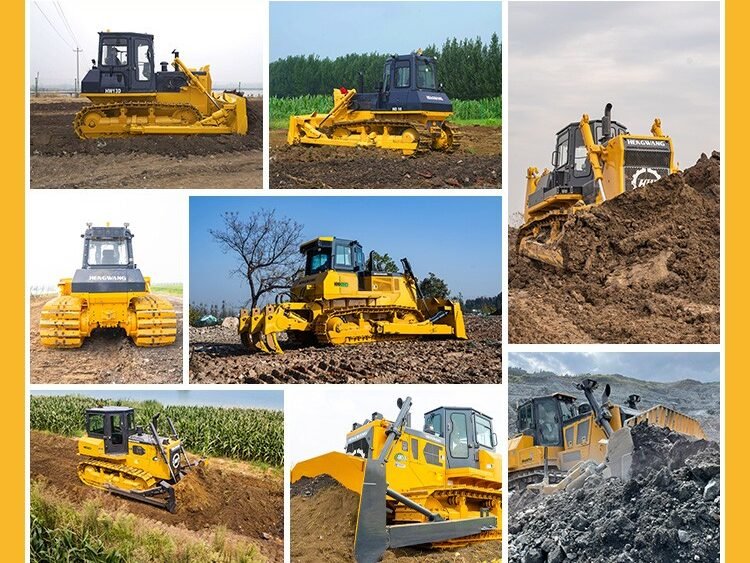
The manufacturing timeline typically ranges from 15 to 45 days, depending on the level of customization. During this period, we conduct:
- Stress Testing: Checking hydraulic systems under maximum load to identify potential seal leaks.
- Functionality Verification: Ensuring all electronic control units (ECUs) and GPS monitoring systems are calibrated correctly.
- Surface Treatment: Applying industrial-grade anti-corrosion coatings, which is vital for machines that will endure weeks of salt-air exposure during sea transit.
We encourage buyers to utilize third-party inspection services like SGS or Intertek. We provide these inspectors full access to our assembly lines to verify that the build quality matches the agreed-upon technical annexes.
How to handle the logistics of shipping heavy equipment?
The logistics phase is where many procurement projects face delays or unexpected costs. Construction machinery is often “Oversized” or “Out of Gauge” (OOG), meaning it cannot fit into a standard 40-foot dry container. Choosing the right shipping method is a balance between cost, safety, and speed.
| Shipping Method | Best For | Advantages |
| Container (HC/FR) | Small excavators, skid steers | Lower cost, protection from elements |
| Roll-on/Roll-off (RORO) | Wheeled loaders, trucks | Simplest loading, no disassembly needed |
| Breakbulk | Large drilling rigs, heavy excavators | Handles extreme weights and dimensions |
| Flat Rack | Wide or tall machinery | Easier to handle than breakbulk for port cranes |
At Hengwang, we often recommend partial disassembly for larger units to fit into High Cube (HC) containers. This significantly reduces freight costs. We provide detailed reassembly manuals and video support so that your local technicians can have the machine operational within hours of arrival.
What are the commercial and payment terms for global export?
In the construction machinery export process, financial security is paramount for both the manufacturer and the buyer. We typically operate under Incoterms 2020, such as FOB (Free on Board), CIF (Cost, Insurance, and Freight), or DAP (Delivered at Place).
For payment, the industry standard is a 30% T/T (Telegraphic Transfer) deposit to initiate production, with the remaining 70% balance paid upon presentation of the Bill of Lading (B/L) or via an Irrevocable Letter of Credit (L/C) at sight. The L/C is particularly useful for large-scale government tenders or multi-unit orders, as it provides a bank-guaranteed layer of trust.
We also manage the “Packing List” and “Commercial Invoice” with precision. These documents must match the shipping marks on the crates exactly to avoid “Demurrage” charges—costly delays at the port caused by paperwork discrepancies.
How does Hengwang simplify the machinery procurement process?
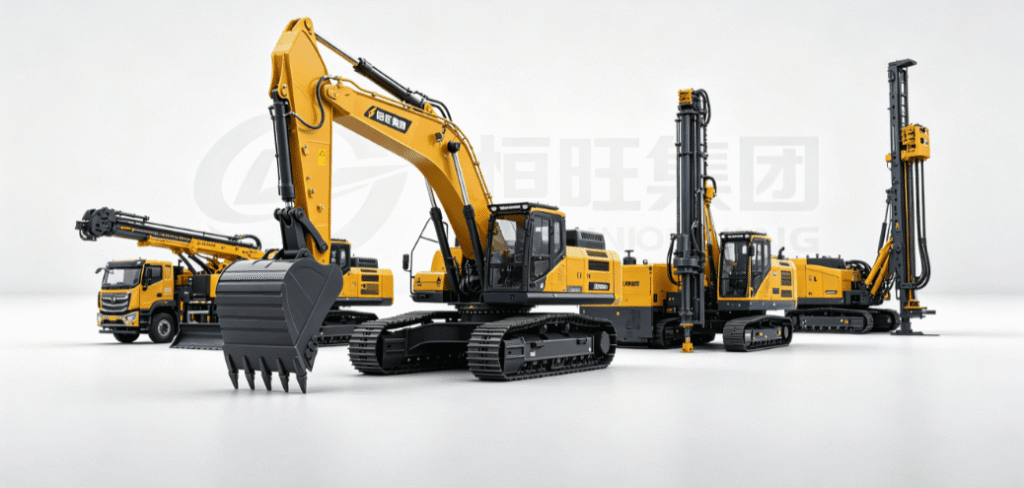
We recognize that for many contractors, importing from China can feel complex. To bridge this gap, we offer an integrated service model. Beyond manufacturing, we assist with the logistics chain, from our factory gates to your nearest port. Our machines, such as the Hengwang series of excavators and drilling rigs, are designed with global serviceability in mind.
We provide a comprehensive “Export Document Package” which includes:
- Original Bill of Lading
- Commercial Invoice and Packing List
- Insurance Certificate (for CIF terms)
- Technical Manuals and Maintenance Schematics
- Warranty Validation Documents
Our goal is to ensure that when the equipment reaches your job site, the transition from “Cargo” to “Working Asset” is seamless. By controlling every variable from raw material sourcing to final customs clearance, we minimize the risks inherent in international heavy equipment trade.
FAQ
Q: What is the typical lead time for an export order?
A: For standard models, production takes 15–20 days. Customized configurations or large fleet orders may require 30–45 days. Shipping time varies by destination, usually 20–40 days by sea.
Q: Can the machinery be customized for specific local power grids?
A: Yes. We can adapt the electrical systems, including chargers for electric models or engine heaters for cold-climate regions, to ensure compatibility with your local infrastructure.
Q: Who is responsible for the machine’s assembly upon arrival?
A: While we offer “Ready-to-Run” shipping via RORO, containerized shipments may require basic assembly. We provide step-by-step video guides and, for large projects, can dispatch engineers for on-site commissioning.
Q: How are warranty claims handled for exported machinery?
A: We provide a global parts warranty. In the event of a component failure, we ship replacement parts via express air freight (DHL/FedEx) to minimize downtime, supported by our remote diagnostic team.
Q: Do you support customs clearance in the destination country?
A: We provide all necessary documentation for clearance. While the buyer usually appoints a local customs broker, we can recommend logistics partners who specialize in heavy machinery in your specific region.
Reference Sources
International Organization for Standardization (ISO) Heavy Machinery
https://www.iso.org/standards.html
CE Marking Requirements for Machinery Safety
https://ec.europa.eu/growth/sectors/mechanical-engineering/machinery_en
Incoterms 2020 Explained by International Chamber of Commerce
https://iccwbo.org/resources-for-business/incoterms-rules/incoterms-2020/