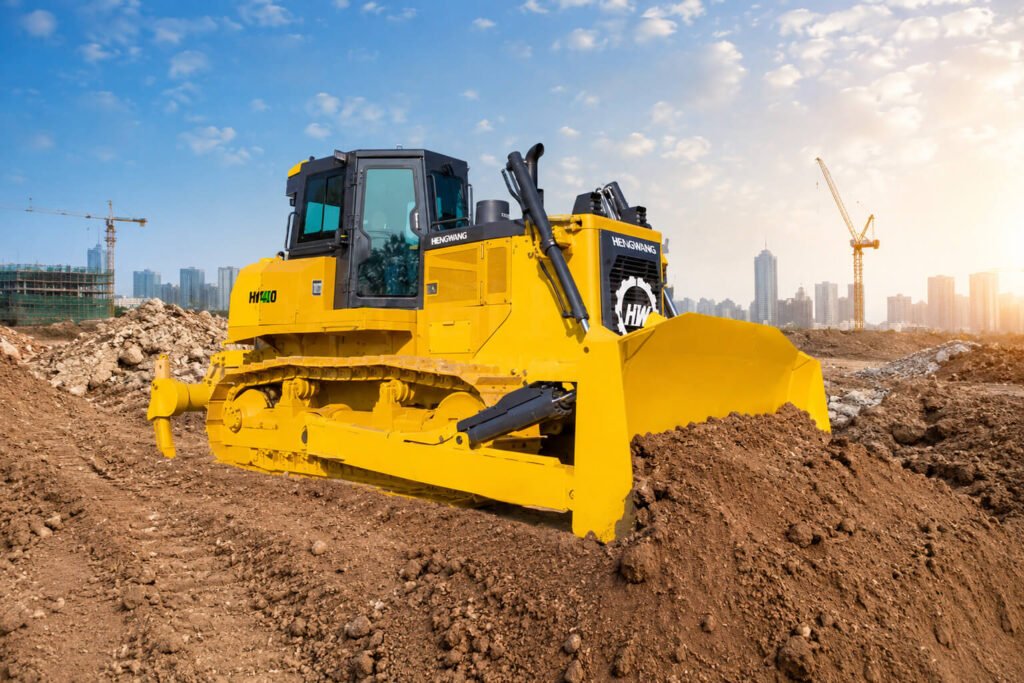
A bulldozer is a high-tractive earthmoving machine equipped with a front-mounted blade and, typically, a rear-mounted ripper. Unlike high-speed transport vehicles, a bulldozer is engineered to deliver maximum “drawbar pull”—the ability to push heavy loads of soil, rock, or debris over short distances through sheer mechanical force.
To understand how a dozer works, one must look at three integrated systems: the powertrain (the source of force), the undercarriage/tracks (the delivery of traction), and the hydraulic system (the precision control of the tool).
The Core Working Principle: Tractive Effort
The fundamental working principle of a bulldozer is the conversion of engine torque into tractive effort. While an excavator uses a bucket to lift material using leverage, a bulldozer uses its entire mass and the friction of its tracks against the ground to displace material.
A dozer succeeds when its tractive force (grip) exceeds the rolling resistance and the weight of the material being pushed. If the material is too heavy or the ground is too slippery, the tracks will “spin out,” indicating the limit of the machine’s mechanical logic.
The Bulldozer Powertrain: Converting Horsepower to Pushing Force
The powertrain is the sequence of components that move power from the engine to the tracks. In a heavy-duty dozer, this is not just about speed; it is about torque multiplication.
1. The Diesel Engine
Modern bulldozers use high-displacement diesel engines designed for high torque at low RPMs. This allows the machine to maintain pushing power under heavy loads without stalling the engine.
2. Torque Converter
The torque converter sits between the engine and the transmission. It uses hydraulic fluid to transfer power, allowing the engine to continue running even if the bulldozer stops because it has hit a massive obstacle. This “fluid coupling” protects the engine from mechanical shock.
3. Planetary Transmission
Most dozers use power-shift planetary transmissions. These allow the operator to change directions (forward to reverse) and gears instantly under load without losing momentum.
4. The Final Drive
The final drive is perhaps the most critical component in the “how it works” equation. It is a system of reduction gears that slows down the rotational speed while significantly increasing the torque delivered to the sprockets. This is what allows a 20-ton machine to push 10 tons of dirt.
How the Undercarriage and Tracks Provide Traction
The “crawler” design is why a bulldozer can operate where other machines fail.
- Low Ground Pressure: By spreading the machine’s weight over the large surface area of two tracks, the “pounds per square inch” (PSI) exerted on the ground is remarkably low. A standard crawler dozer may exert less pressure on the ground than a human foot, preventing it from sinking into soft mud or sand.
- Grousers (Track Shoes): The metal bars on the track shoes, called grousers, act like claws. They penetrate the ground to provide the friction necessary to utilize the engine’s torque.
- The Undercarriage Chain: A system of rollers, idlers, and sprockets keeps the track under tension and allows it to rotate smoothly over uneven terrain.
The Hydraulic System: Blade Operation
If the powertrain is the heart, the hydraulic system is the muscle. It allows the operator to manipulate the heavy steel blade with millimeter precision.
Blade Movements Explained:
- Lift: Moving the blade up or down to determine the depth of the cut.
- Tilt: Dipping one side of the blade lower than the other. This is used for ditching or “breaking” hard ground.
- Angle (in some models): Swiveling the blade left or right to side-cast material.
- Pitch: Changing the vertical angle of the blade face. A “pitched back” blade carries more material; a “pitched forward” blade cuts better.
These movements are powered by high-pressure hydraulic pumps that send fluid to double-acting cylinders. When the operator moves a joystick, a control valve directs fluid to one side of the cylinder piston, forcing the blade to move.
Crawler Dozer vs. Wheel Dozer Working Principles
| Feature | Crawler Dozer (Tracked) | Wheel Dozer |
| Traction Source | Steel tracks with grousers | Rubber tires |
| Ground Pressure | Very low (ideal for soft soil) | High (ideal for firm ground) |
| Mobility | Low speed, excellent on slopes | High speed, better for long distances |
| Best Use Case | Land clearing, heavy grading | Pit cleanup, stockpile maintenance |
Rear Attachments: The Ripper
A bulldozer often works “backward” before it works “forward.” The ripper is a claw-like device on the rear. Its working principle involves using the machine’s weight to drive a heavy shank into compacted soil or soft rock, breaking it up into manageable pieces so that the front blade can then push it away.
Summary
A bulldozer works by leveraging its massive weight and engine torque through a series of gear reductions (powertrain) to provide grip (undercarriage), while using pressurized fluid (hydraulics) to move earth via a front-mounted blade. Choosing the right machine requires balancing horsepower, operating weight, and the specific blade type for the terrain at hand.
FAQ
1. Why do bulldozers use tracks instead of wheels?
Tracks provide a larger surface area, which leads to lower ground pressure and higher traction. This allows bulldozers to work on soft, muddy, or sandy terrain where wheeled vehicles would sink or lose grip.
2. Can a bulldozer dig deep holes?
While a bulldozer can excavate by “stripping” layers of soil, it is not designed for deep vertical digging. An excavator is the better tool for deep holes or trenches. A dozer is optimized for horizontal material movement and surface grading.
3. What is the “Final Drive” in a bulldozer?
The final drive is the last set of reduction gears before power reaches the tracks. It reduces rotational speed to increase torque, providing the immense pushing power dozers are known for.
4. How does a bulldozer steer?
Crawler dozers steer by varying the speed or direction of the tracks. To turn left, the left track is slowed or stopped while the right track continues to move forward. Modern dozers use hydrostatic drives or steering clutches to achieve this smoothly.
Reference Sources
Caterpillar (Equipment Basics): “The Cat® Powertrain: Total Integration.” https://www.cat.com/
Society of Automotive Engineers (SAE): Technical standards for Crawler Tractor Tractive Effort (J701).
OSHA (Safety & Operation): Heavy Equipment Safety Guidelines for Earthmoving. https://www.osha.gov/