Bulldozer ground pressure is the amount of machine weight exerted on the soil per square inch, typically measured in PSI (pounds per square inch) or kPa. It dictates whether a machine will float over soft terrain or sink into it. Standard dozers usually exert between 6 and 9 PSI, making them highly effective for heavy pushing on firm ground. In contrast, Low Ground Pressure (LGP) dozers feature wider and longer tracks to distribute weight over a larger area, reducing pressure to roughly 3 to 5 PSI. While LGP dozers are required for mud and swamps, operating them on hard surfaces significantly accelerates undercarriage wear.
What Is Bulldozer Ground Pressure and How Is It Calculated?
Ground pressure is a mechanical ratio determining the relationship between the downward force of the equipment and the bearing capacity of the soil. When a machine’s ground pressure exceeds the soil’s bearing capacity, the tracks will break the surface tension, causing the dozer to sink, lose traction, and potentially stall the operation.
To calculate the average ground pressure of a crawler dozer, engineers use the machine’s operating weight and its Ground Contact Area (GCA).
The Formula:
Ground Pressure (PSI) = Operating Weight (lbs) / Ground Contact Area (sq. inches)
Calculating Ground Contact Area:
- Measure the width of a single track shoe.
- Measure the length of the track resting on the ground (from the front idler to the rear sprocket).
- Multiply the track width by the length on the ground.
- Multiply that number by 2 (accounting for both tracks).
Example Calculation:
If a bulldozer has an operating weight of 32,000 lbs, a track shoe width of 30 inches, and a track on ground length of 106 inches:
- Total GCA = 30 in. × 106 in. × 2 = 6,360 sq. inches.
- Ground Pressure = 32,000 lbs / 6,360 sq. inches = 5.03 PSI.
Why Ground Pressure Matters: Flotation vs. Tractive Effort
Choosing the correct ground pressure involves balancing two opposing engineering principles: flotation and tractive effort.
Flotation is the ability of a machine to remain on top of soft or wet material. Lower ground pressure results in higher flotation. This acts similarly to a snowshoe, spreading a heavy load across a wide footprint to prevent sinking.
Tractive Effort (Drawbar Pull) is the amount of usable pushing or pulling force a machine can generate before the tracks spin. To generate tractive effort on hard ground, the grousers (the raised steel bars on the track shoes) must physically penetrate the soil.
A common operational misconception is that a wider track always provides more pushing power. In reality, on highly compacted clay or hardpan, an LGP dozer spreads its weight too thinly. The reduced ground pressure prevents the grousers from biting into the hard dirt, causing the tracks to spin across the surface and drastically reducing the machine’s pushing capacity.
Standard Dozers: Specs and Applications
Standard crawler dozers (often designated without a suffix, or with an “EX” in some manufacturer naming conventions) are engineered for maximum productivity on stable, load-bearing ground.
- Typical Ground Pressure: 6 to 9 PSI for mid-sized machines, reaching up to 13 PSI on heavy mining models.
- Track Shoe Width: Generally narrower, ranging from 18 to 24 inches (45 to 60 cm) depending on the machine class.
- Undercarriage Geometry: Narrower track gauge keeps the machine footprint compact.
Standard configurations are optimal for heavy ripping, aggressive slot dozing, quarrying, and stump removal. Because the tracks apply a concentrated load, standard dozers excel in abrasive conditions containing rock, gravel, and hard-packed clay. The narrower tracks also allow the machine to remain agile, minimizing the leverage forces that twist the undercarriage during sharp turns.
LGP Dozers (Low Ground Pressure): Engineering Flotation
An LGP dozer is specifically modified at the factory to navigate unstable terrain where a standard machine would bog down. Manufacturers achieve this lower ground pressure through a combination of a wider track gauge, an extended track frame, and significantly wider track shoes.
- Typical Ground Pressure: 3 to 5 PSI for mid-sized machines.
- Track Shoe Width: Often 30 to 36 inches (75 to 90 cm), sometimes doubling the width of a standard configuration.
- Modifications: The undercarriage is spaced further apart from the main frame to accommodate the massive tracks without interfering with the chassis.
LGP dozers are mandatory for projects involving peat bogs, swamp clearing, landfill management, and pipeline construction in rainy seasons. Beyond wet conditions, LGP dozers are highly favored for finish grading and slope work. The wide footprint provides exceptional side-to-side stability on inclines and minimizes rutting, leaving a smoother surface behind the blade.
XL, XW, and Swamp Dozers: Other Track Configurations
The choice is rarely just between standard and LGP. Manufacturers offer intermediate and specialized configurations based on ground pressure needs:
- XL (Extra Long): Features the narrow track width of a standard dozer but extends the length of the track frame. This slightly reduces ground pressure while shifting the center of gravity forward, making it an excellent choice for fine grading without the extreme width of an LGP.
- XW (Extra Wide): A hybrid configuration sitting between standard and LGP. It offers better flotation than a standard dozer but maintains more grouser penetration than a full LGP model.
- Swamp Dozers: A highly specialized sub-category of LGP. Swamp dozers utilize apex shoes (triangular track pads) designed specifically to prevent thick mud from packing into the track chains.
Standard vs LGP Dozers: Technical Comparison
Evaluating these configurations requires looking at the physical limits they place on the machine.
| Feature | Standard Track Dozer | LGP (Low Ground Pressure) Dozer |
| Typical Ground Pressure | 6.0 – 9.0 PSI | 3.0 – 5.0 PSI |
| Track Shoe Width | Narrow (18″ – 24″) | Wide (30″ – 36″+) |
| Primary Engineering Focus | Grouser penetration, heavy pushing | Flotation, minimal surface disturbance |
| Ideal Soil Conditions | Hardpan, rock, highly abrasive materials | Mud, wetlands, loose sand, snow |
| Side-Slope Stability | Standard baseline | Superior (due to wider track gauge) |
| Turning Resistance | Normal | High (can cause accelerated component wear) |
The Maintenance Trade-Off: Undercarriage Wear
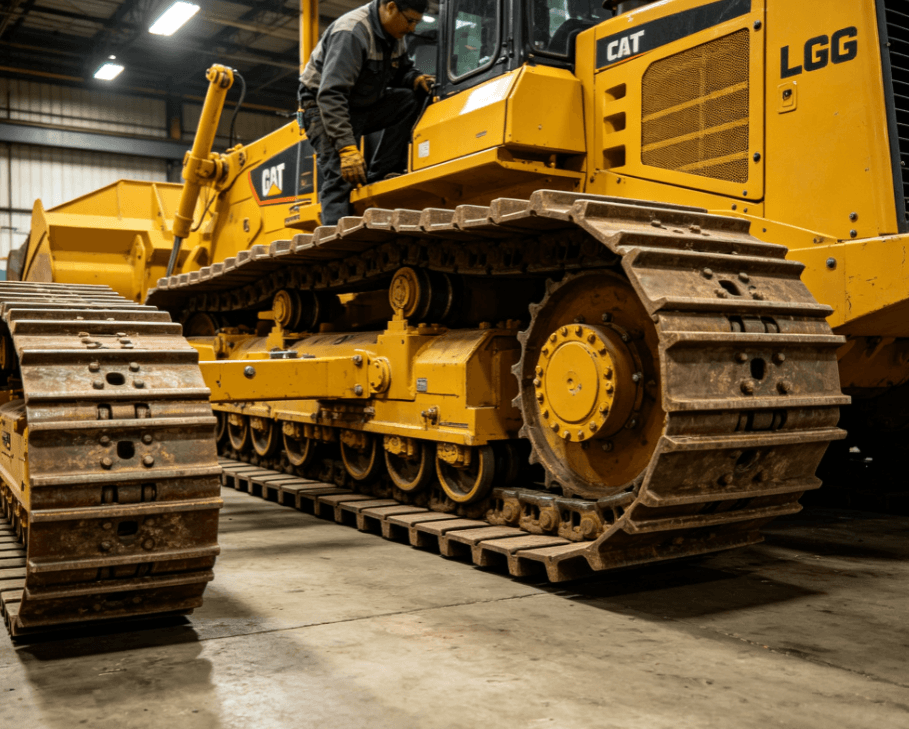
The flotation capabilities of an LGP dozer introduce significant mechanical trade-offs. The undercarriage is the single most expensive component of any crawler dozer, frequently accounting for 50% to 60% of total lifetime maintenance costs.
Dozers steer by slowing or stopping one track while the other continues to drive. When an LGP dozer turns, its extra-wide tracks create massive friction—a “scrubbing” effect—against the ground. On soft mud, the soil yields, and the wide tracks slide with minimal resistance.
However, if an operator runs an LGP dozer on hard, dry, or rocky surfaces, the ground does not yield. Instead, severe torsional stress is transferred directly into the track chain. This accelerated friction causes premature wear on the pins, bushings, track rollers, and idlers. Deploying an LGP machine in a hard-rock quarry is one of the fastest ways to destroy a track group.
Transport and Blade Matching Considerations
Ground pressure modifications impact more than just the dirt; they affect logistics and equipment attachments.
Transport Restrictions:
Because LGP dozers have a significantly wider track gauge to accommodate their wide shoes, they often exceed standard highway transport width limits. While a standard dozer might easily fit on a commercial lowboy trailer, an equivalent LGP model may require special oversized-load permits, pilot cars, and restricted travel routing, which inflates transportation costs.
Blade Matching:
An LGP dozer cannot use a standard blade. The blade must be wide enough to clear material away from the outer edges of the oversized tracks. If a standard-width Power-Angle-Tilt (PAT) blade is installed on an LGP undercarriage and angled to the side, the rear corner of the blade will fall inside the track path. The dozer will subsequently drive over its own windrowed material, causing an uneven ride and ruining fine grading efforts. Therefore, LGP dozers require specialized, wider blades, which operators must manage carefully to avoid overloading the engine.
How to Choose the Right Dozer Configuration
A bulldozer is most effective when its ground pressure is accurately matched to the project’s primary terrain. Evaluate the following before procurement or deployment:
- Assess Soil Bearing Capacity: If the site involves reclaimed land, wetlands, or frequent heavy rains, an LGP dozer is necessary to maintain productivity and prevent machines from sinking.
- Evaluate Material Type: For ripping rock, dozing highly abrasive materials, or working on hard-packed ground, a standard configuration provides the necessary tractive effort and prevents premature undercarriage destruction.
- Review the Turning Frequency: If the job requires constant, tight maneuvering in a confined space on firm ground, an LGP dozer will incur massive maintenance penalties.
- Consider Alternative Equipment: If the goal is simply low surface disturbance on hard terrain with frequent relocation, a wheeled machine or alternative earthmover may be more appropriate than manipulating crawler ground pressures.
By balancing flotation requirements with undercarriage wear factors, contractors can select the configuration that maximizes uptime and lowers the cost per yard of material moved.
FAQ
Q: How much ground pressure does a standard bulldozer have?
A: A standard mid-sized crawler dozer typically exerts between 6 and 9 PSI (pounds per square inch). Larger mining dozers can exert 13 PSI or more. This concentrated pressure allows the track grousers to penetrate firm ground for optimal pushing power.
Q: What does LGP stand for on a bulldozer?
A: LGP stands for Low Ground Pressure. It designates a bulldozer equipped with a wider track gauge, a longer track frame, and wider track shoes. This configuration distributes the machine’s weight over a larger area, preventing it from sinking in mud or soft soil.
Q: Can you use an LGP dozer on hard or rocky ground?
A: While it is physically possible, operating an LGP dozer on hard, rocky, or paved ground is highly discouraged. The wider tracks create excessive friction when turning on firm surfaces, which accelerates wear on pins, bushings, and rollers, drastically increasing maintenance costs.
Q: How do you calculate the ground contact area of a dozer?
A: To calculate ground contact area, measure the width of a single track shoe, multiply it by the length of the track that rests flat on the ground, and then multiply that total by two (to account for both tracks).
Q: Why do LGP dozers need wider blades?
A: An LGP dozer has a wider overall track stance. If a standard blade is used, especially when angled, the tracks will roll over the material the blade is pushing aside (the windrow). A wider blade ensures the material is pushed entirely outside the tracks’ path.
Reference
Chapter 4: Tractors and Dozers (Earthmoving Equipment Ground Pressure & PSI Specifications) – King Saud University (CE 417)
Ground Pressure (Formula & Footprint Calculation) – Digger Mats NI
Hengwang Group Technical Support – Dozer Operational and Maintenance Documentation.