Choosing the right mining drilling rig supplier involves more than comparing machine prices. International buyers, mining contractors, and distributors should evaluate drilling requirements, equipment capability, supplier reliability, after-sales support, and total cost of ownership before making a decision.
For some projects, a compact hydraulic or pneumatic rig may be sufficient. More demanding applications may require DTH, geological exploration, reverse circulation, or other specialized drilling equipment. The right supplier should be able to match the equipment configuration to the actual site requirements.
.png)
Why Choosing the Right Mining Drilling Rig Supplier Matters
A drilling rig can directly affect project productivity, operating costs, downtime, and site safety. Before comparing suppliers, define the basic application requirements, including drilling method, target depth, bore diameter, ground conditions, and site mobility.
Supplier capability is equally important. A manufacturer should be able to provide clear technical specifications, suitable configurations, spare parts, maintenance information, and support throughout the equipment lifecycle.
What Technical Specifications Should Buyers Compare?
A practical comparison should cover more than maximum drilling depth. Key specifications include:
- Drilling method: Determine whether the project requires DTH, core, reverse circulation, pneumatic, hydraulic, or another drilling method.
- Depth and diameter: Confirm that the rig can achieve the required depth and bore diameter with the intended tooling.
- Power system: Check engine or prime mover power and compatibility with the operating environment.
- Rotation and lifting capability: Review torque, lifting capacity, feed performance, and rotation speed where applicable.
- Mobility: Determine whether a tracked, trailer-mounted, truck-mounted, or other configuration is suitable.
- Tooling compatibility: Confirm drill rods, bits, compressors, pumps, and other required accessories.
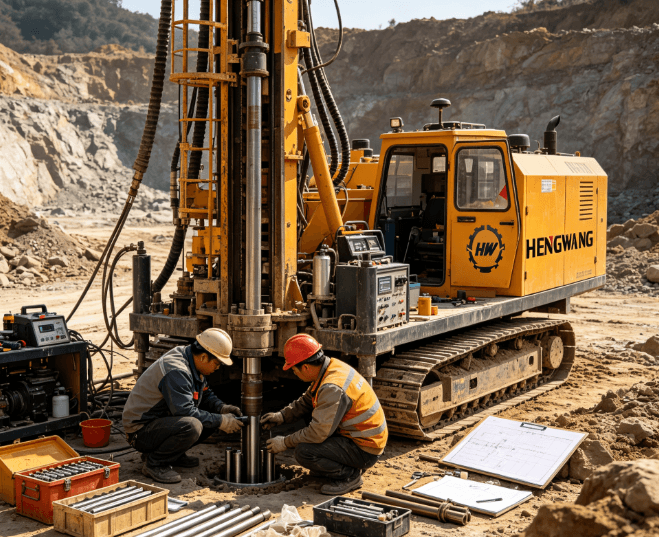
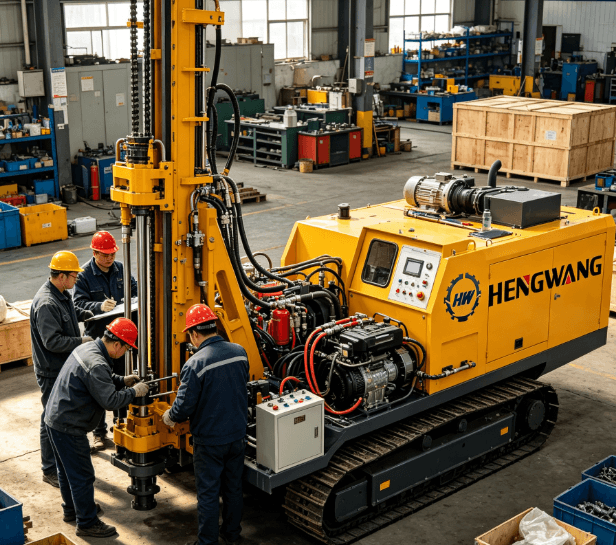
HengWang’s current drilling rig range covers several equipment categories, including hydraulic drilling rigs, pneumatic drilling rigs, geological exploration rigs, horizontal directional drilling rigs, and DTH drilling rigs. This allows buyers to compare different equipment platforms according to application rather than selecting a machine based only on price.
Mining Drilling Rig Supplier Evaluation Checklist
| Decision Factor | Procurement Question | Priority |
|---|---|---|
| Drilling method | Is DTH, core, reverse circulation, pneumatic, hydraulic, or another method required? | High |
| Depth & diameter | Can the rig achieve the required depth and bore diameter with the planned tooling? | High |
| Power & mobility | What power source and mobility configuration does the project require? | Medium |
| Spare parts & service | Are critical spare parts available and can the supplier provide technical support? | High |
| Commercial terms | What are the payment, delivery, warranty, and commissioning terms? | High |
| Compliance & documentation | Can the supplier provide manuals, drawings, parts lists, and required documentation? | Medium |
| Reference projects | Can the supplier provide verifiable references for similar applications? | Medium |
Manufacturer vs. Distributor vs. OEM Partner
Buyers typically choose between a direct manufacturer, regional distributor, or OEM partner.
A manufacturer can be a good choice when customization, factory communication, and direct technical support are important. A regional distributor may be preferable when local service, spare-parts stocking, and faster response are priorities. OEM cooperation can make sense when equipment needs to be adapted to a particular application or integrated into an existing equipment portfolio.
Before selecting a supplier, compare not only the initial machine price but also tooling, shipping, commissioning, spare parts, maintenance, and expected downtime.
Buyers can review HengWang’s drilling rigs category to compare available drilling platforms and identify models that match their initial technical requirements.
How to Evaluate Supplier Risk and Compliance
Supplier verification should cover both the company and the equipment. Request:
- Company and manufacturing information
- Technical drawings and equipment specifications
- Parts lists and maintenance manuals
- Warranty and commissioning terms
- Production and delivery schedules
- References from comparable projects
- Information on quality-control procedures
For mining projects, site safety and regulatory requirements should also be considered. In the United States, for example, MSHA provides resources covering mining safety and mobile equipment hazards. Its guidance highlights areas such as braking, steering, hydraulic systems, operator visibility, and other mobile-equipment risks. Buyers should determine which requirements apply to their specific mine, equipment, and operating conditions. (MSHA)
Quality-management systems can provide another useful supplier-screening reference. ISO 9001 is an internationally recognized quality management standard covering processes for consistently meeting customer and applicable requirements. Certification can support supplier evaluation, although it should be considered alongside actual manufacturing capability, technical documentation, references, and product performance. (ISO 9001)
How to Compare Total Cost of Ownership
The lowest quotation is not always the lowest-cost option. Procurement teams should consider:
Total cost = equipment + tooling + shipping + commissioning + spare parts + maintenance + expected downtime
A lower-priced drilling rig can become more expensive if critical parts have long lead times or if technical support is difficult to access.
When requesting quotations, ask suppliers to separate the machine price from optional tooling, spare-parts packages, shipping terms, warranty coverage, and after-sales services. This makes different mining drilling rig suppliers easier to compare on a like-for-like basis.
Shortlisting and Supplier Verification Process
A practical sourcing process can follow five steps:
| Step | Action |
|---|---|
| 1 | Define the drilling method, depth, diameter, ground conditions, and site requirements. |
| 2 | Compare suppliers and models that meet the basic technical requirements. |
| 3 | Request technical documents, parts lists, warranty terms, and supplier references. |
| 4 | Compare total cost of ownership, including logistics and after-sales support. |
| 5 | Arrange technical discussions, demonstrations, or site evaluations before placing a major order. |
For example, HengWang’s DTH range includes models such as the HW916 Separated DTH Surface Drill Rig, designed for small and medium-sized quarry and contractor applications, with a 78 kW rated engine and 90–100 mm drilling diameter listed on its product page.
For larger-diameter reverse circulation applications, the HW-RC500 Reverse Circulation Drill Rig is listed with a maximum drilling depth of 400 m, a 105–400 mm drilling diameter range, and 132 kW engine power.
These examples illustrate why buyers should compare drilling method, depth, diameter, power, and tooling requirements together rather than relying on a single specification.
Explore Mining Drilling Rig Options
Once the technical requirements are clear, buyers can compare suitable models and request quotations based on actual project conditions.
The HengWang drilling rig range provides access to different equipment categories, while individual product pages can be used to review model-specific specifications before contacting the supplier. HengWang also identifies itself as a manufacturer integrating R&D, manufacturing, sales, and after-sales service.
For buyers evaluating specific drilling configurations, the product information should be treated as a starting point for technical discussions. Final specifications, tooling, compliance requirements, delivery terms, warranty coverage, and after-sales support should be confirmed with the supplier before purchase.
Frequently Asked Questions
What documents should I request from a mining drilling rig supplier?
Request equipment drawings, technical specifications, parts lists, maintenance manuals, warranty terms, and commissioning information. These documents help confirm equipment compatibility and expected lifecycle support.
How do I verify spare-part availability in my region?
Ask for critical spare-parts lists, lead times, recommended spare kits, and information about regional service or distribution partners. This is particularly important where equipment downtime can significantly affect project costs.
Should I buy directly from a manufacturer or use a distributor?
Direct sourcing can provide closer communication with the manufacturer and more customization options. A distributor may offer advantages in local service and spare-parts availability. The better option depends on project location, order volume, customization requirements, and support needs.
How much does a mining drilling rig cost?
Mining drilling rig prices vary significantly according to drilling method, depth and diameter capacity, power system, tooling, automation, and configuration. Buyers should compare total cost of ownership rather than judging suppliers only by the initial machine price.
How can I reduce supplier risk?
Use a structured supplier questionnaire, verify technical documents and references, clarify warranty and logistics responsibilities, and consider staged purchasing or equipment testing before committing to a large order. For safety-sensitive applications, confirm applicable regulatory requirements before deployment.