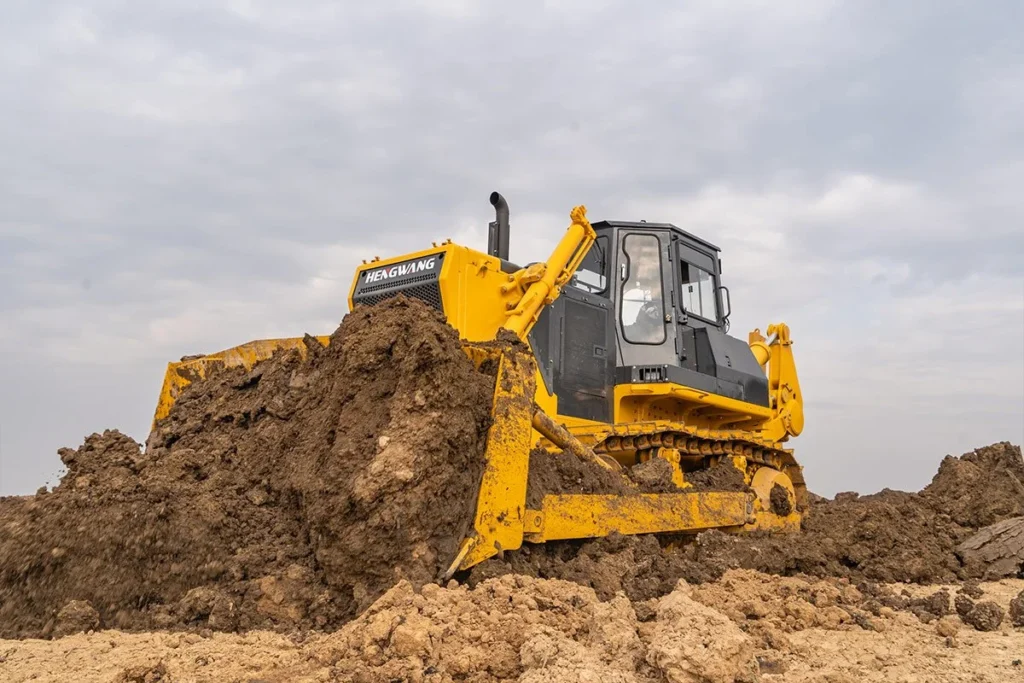
The main types of bulldozer blades are the S-Blade (Straight), U-Blade (Universal), SU-Blade (Semi-U), and PAT Blade (Power-Angle-Tilt). A bulldozer relies on these front-mounted attachments to cut, push, and grade materials. The shape, width, and side-wing design of the blade dictate how well the machine penetrates hard soil or retains loose material over long distances.
Selecting the correct dozer blade prevents material spillage, maximizes the volume moved per pass, and matches the pushing load to the machine’s drawbar pull.
Core Bulldozer Blade Types Compared
Different projects require different balances of ground penetration force and material carrying capacity.
| Blade Type | Physical Characteristics | Penetration Force | Material Retention | Ideal Applications |
| S-Blade (Straight) | Flat face, no side wings | Very High | Low (High spillage) | Stumping, ditching, hard soil, rock ripping |
| U-Blade (Universal) | Tall profile, deep curve, large side wings | Low | Very High | Coal, wood chips, loose dirt, long-distance pushing |
| SU-Blade (Semi-U) | Moderate curve, short side wings | High | Moderate | General construction, heavy dirt, mixed rock |
| PAT Blade (6-Way) | Pitch, angle, and tilt functions via hydraulics | Moderate | Low | Finish grading, backfilling, landscaping |
| Angle Blade | Straight face, pivots left or right (usually 25°) | High | Low | Side-casting material, snow removal, road maintenance |
S-Blade (Straight Blade): Maximum Penetration for Hard Ground
The S-Blade, or straight blade, is the simplest and most robust blade design. It features a flat moldboard without any forward-angling side wings.
Because it lacks wings, the machine’s pushing force is concentrated directly along a shorter cutting edge. This high concentration of force per square inch gives the S-Blade exceptional ground penetration capabilities. It is typically mounted to the dozer via outside push arms, providing structural rigidity when hitting unyielding obstacles.
Key Advantages:
- Drives immense force into highly compacted soils, clay, and frozen ground.
- Ideal for stumping (removing tree stumps) and prying embedded boulders.
- Excellent for cutting v-ditches and initial site pioneering.
Limitations:
- Poor material retention. When pushing material forward, dirt quickly spills off the open sides.
- Inefficient for long-distance material hauling or mass earthmoving.
U-Blade (Universal Blade): High Capacity for Loose Materials
The U-Blade is designed for maximum volumetric capacity. It features a tall moldboard, a pronounced vertical curve, and large side wings that angle forward significantly.
The curved moldboard creates a continuous rolling action. Instead of just plowing the dirt, a U-Blade rolls the material forward, reducing friction against the ground. The large side wings trap the material, allowing the bulldozer to push massive loads over longer distances without side spillage.
Key Advantages:
- Carries the highest volume of material per pass compared to other blade types.
- Highly efficient for lighter, low-density materials like coal, wood chips, stockpile sand, and topsoil.
- Reduces the number of passes required to clear a large, loose area.
Limitations:
- Lower penetration force. Because the blade is wider, the machine’s hydraulic down-pressure and pushing force are distributed over a larger cutting area.
- Struggles in highly compacted, rocky, or hard-pan soils.
- Requires a high-horsepower bulldozer to overcome the friction of moving such a large volume of material.
SU-Blade (Semi-U Blade): The Versatile Standard
The Semi-U (SU) blade bridges the gap between the S-Blade and the U-Blade, making it the industry standard for medium and large crawler dozers used in general construction.
An SU-Blade incorporates the basic shape of a straight blade but adds short side wings. It has a slight curve to assist with material rolling. This hybrid design allows it to retain more material than a straight blade while maintaining much better ground penetration than a universal blade.
Key Advantages:
- Excellent balance of penetration and capacity.
- Capable of handling a wide variety of materials, from blasted rock to heavy, wet dirt.
- Can be equipped with heavy-duty rock guards and wear plates for severe quarry or mining applications.
- Reduces the need to swap blades when a single job site has mixed soil conditions.
Limitations:
- Not as efficient as a U-Blade for stockpiling light materials.
- Does not penetrate solid hard-pan quite as well as a pure S-Blade.
Straight Blade vs. Universal Blade: Key Technical Differences
When deciding specifically between an S-Blade and a U-Blade, the choice comes down to cutting vs. carrying.
- Force Distribution: An S-Blade concentrates the tractor’s horsepower into a small cutting area, maximizing digging power. A U-Blade spreads that same horsepower across a wider area, maximizing load size but sacrificing digging power.
- Pushing Distance: If the project requires pushing material 20 feet to grade a surface, an S-Blade or PAT blade works well. If the material must be pushed 150 feet across a site, the S-Blade will lose most of its load to side spillage before reaching the destination. The U-Blade will hold the load for the entire distance.
- Machine Matching: U-Blades are generally reserved for large production dozers (over 250 HP) or specialized machines working in coal handling and landfill applications. S-Blades are often found on smaller to mid-sized clearing tractors.
Angle Blade and PAT Blade: Precision Grading Attachments
While S, U, and SU blades handle mass earthmoving, other blades are engineered for precision and directional material placement.
Angle Blade
An Angle Blade mounts to a C-frame on the dozer rather than standard outside push arms. It can be manually or hydraulically angled left or right, typically up to 25 degrees.
- Function: Instead of pushing dirt straight ahead, an angle blade continuously rolls material off to one side as the tractor moves forward (side-casting).
- Applications: Backfilling long pipeline trenches, cutting hillside roads, snow clearing, and maintaining gravel haul roads.
PAT Blade (Power-Angle-Tilt)
The PAT Blade, or 6-way blade, is the ultimate tool for fine grading. It can be raised, lowered, angled left or right, and tilted up or down, all controlled hydraulically from the operator’s joystick.
- Function: Allows the operator to create precise slopes, crowns, and contours in a single pass.
- Applications: Finish grading, landscaping, golf course construction, and residential site prep.
- Limitation: The complex hydraulic C-frame mechanism is heavier and less structurally rigid than standard push arms. Therefore, PAT blades are usually restricted to compact and medium dozers (typically under 130 HP) and are not suitable for heavy rock ripping or stumping.
How Blade Capacity is Measured (SAE J1265)
Manufacturers state blade capacity in cubic yards or cubic meters, generally adhering to the SAE J1265 standard.
This engineering standard calculates the volume of material a blade can hold based on its width, height, and wing contour, assuming a specific natural angle of repose for the dirt (usually a 2:1 slope from the top of the blade down to the cutting edge).
When comparing specifications across brands, verifying that capacity is measured via SAE J1265 ensures an accurate volume comparison. However, actual job-site capacity will vary based on operator skill, whether the machine is pushing uphill or downhill, and the moisture content of the soil.
Factors to Consider When Choosing a Dozer Blade
Selecting the right bulldozer blade requires evaluating the project environment and the base machine’s capabilities.
1. Material Density and Soil Type
Heavier, cohesive materials (like wet clay) require blades with high penetration and structural strength, such as SU or S-blades. Lighter, loose materials (like dry topsoil, sand, or coal) allow the use of high-capacity U-blades. Using a massive U-blade in dense, rocky soil will cause the machine’s tracks to spin because the blade will encounter more resistance than the tractor has traction.
2. Pushing Distance
The further material needs to be pushed, the more critical side wings become.
- Short push (0–50 feet): S-Blade or PAT blade is acceptable.
- Medium push (50–100 feet): SU-Blade prevents excessive windrowing (spillage).
- Long push (100+ feet): U-Blade is required, often utilizing a technique called slot dozing (pushing dirt through a pre-cut trench to trap material on all sides) to maximize efficiency.
3. Machine Horsepower and Traction
A blade is only as effective as the tractor pushing it. The bulldozer must have sufficient engine horsepower and undercarriage traction (ground contact area) to overcome the resistance of a loaded blade. Mounting an oversized blade on a mid-size crawler dozer will lead to increased track slip, accelerated undercarriage wear, and higher fuel consumption without increasing actual production.
Summary: Matching the Blade to the Project
A bulldozer’s efficiency is directly tied to its front attachment. S-Blades are required for hard digging and stumping. U-Blades excel at moving massive volumes of loose material over distance. SU-Blades offer the most versatile middle ground for general heavy construction, while PAT blades dominate fine grading and finishing work.
When evaluating equipment for a project, contractors must align the blade geometry with the soil density, push distance, and available tractive force of the machine. For buyers assessing complete machine configurations, exploring available crawler bulldozers can clarify how different engine classes pair with specific blade capacities.
FAQ
What is the difference between a straight blade and a universal blade?
A straight blade (S-blade) has a flat profile with no side wings, designed to concentrate force for deep soil penetration and rock prying. A universal blade (U-blade) has a tall, curved profile with large forward-angled wings, designed to carry maximum material volume over longer distances without side spillage.
What does a Semi-U (SU) blade do?
An SU-blade combines features of both S and U blades. It has a moderate curve and short side wings. This allows it to retain more material than a straight blade while maintaining better ground penetration than a full U-blade. It is the most common standard blade for medium-to-large construction dozers.
When should I use a PAT blade on a bulldozer?
A Power-Angle-Tilt (PAT) blade should be used when a project requires precision finish grading, contouring, or backfilling. Because the operator can hydraulically adjust the pitch, angle, and tilt, it is ideal for landscaping and shaping roads. It is typically found on smaller dozers and should not be used for heavy rock digging.
What is slot dozing?
Slot dozing is an earthmoving technique where the bulldozer pushes material through a continuous trench (the “slot”). The earthen walls of the trench act as extensions of the blade’s side wings, preventing material from spilling off the sides. This technique significantly increases the volume of dirt moved per pass, especially when paired with a U-blade or SU-blade.
How is bulldozer blade capacity calculated?
Blade capacity is generally calculated using the SAE J1265 industry standard. This formula considers the blade’s width, height, and wing dimensions to estimate the volume of earth it can hold, assuming the dirt forms a natural sloping pile against the blade face.
Reference Sources
SAE J1265: Dozer Capacity Standard:SAE International (Society of Automotive Engineers)
Caterpillar Performance Handbook:Caterpillar Inc.