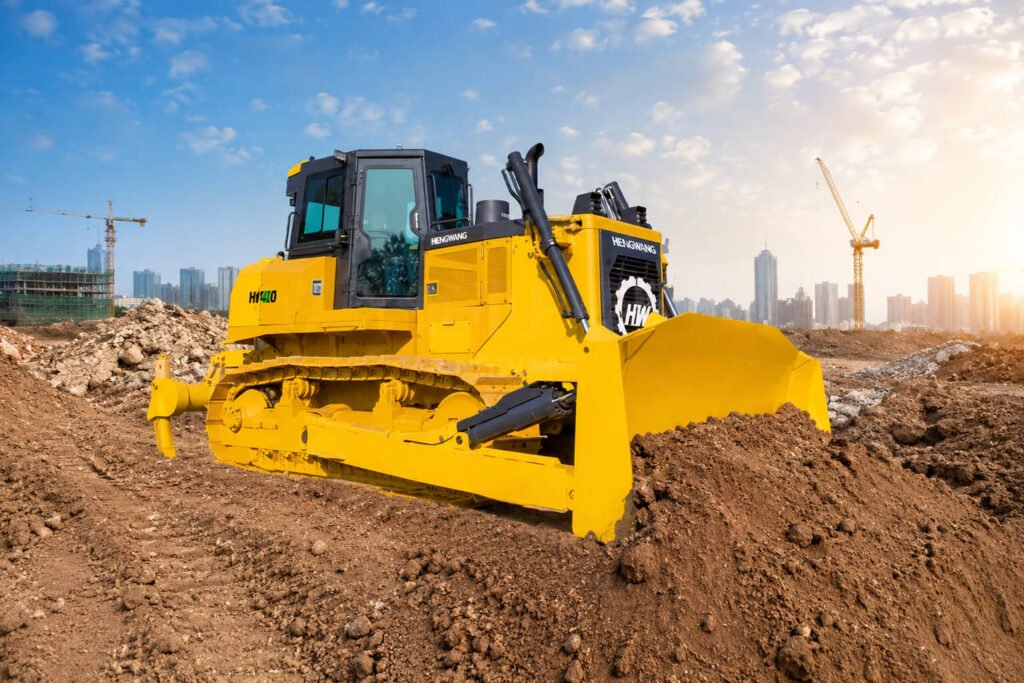
A bulldozer is a heavy earthmoving machine designed to push, spread, and grade material using a front-mounted blade. While the blade is its most recognizable feature, a bulldozer’s performance depends on the integration of three primary systems: the undercarriage, the drivetrain, and the hydraulic work tools.
Understanding bulldozer anatomy is essential for operators, maintenance technicians, and buyers to ensure machine longevity and operational efficiency.
The Undercarriage: The Foundation of Bulldozer Performance
The undercarriage is the most complex and expensive part of a crawler bulldozer, often accounting for nearly 50% of total maintenance costs over the machine’s life. Its primary role is to provide traction and distribute the machine’s massive weight to minimize ground pressure.
Tracks, Shoes, and Chains
The track system allows the dozer to operate on steep slopes and in soft mud where wheeled vehicles would sink.
- Track Shoes: These are the steel plates that make direct contact with the ground. They often feature “grousers”—raised bars that bite into the soil for traction.
- Track Chains: A series of links pinned together that provide the continuous loop for the wheels to travel on.
- Pins and Bushings: These act as the joints in the track chain. Lubricated tracks (SALT) use oil to reduce internal friction between these parts.
Idlers, Rollers, and Sprockets
- Drive Sprocket: Located at the rear, this geared wheel connects to the final drive and pulls the track chain, providing the force to move the machine.
- Front Idler: A large, smooth wheel at the front that maintains track tension and helps absorb shocks from obstacles.
- Track Rollers: These smaller wheels support the weight of the machine and guide the tracks. There are “bottom rollers” (carrying the weight) and “carrier rollers” (supporting the track’s return on top).
The Blade Assembly: The Primary Work Tool
The blade is the heavy metal plate used to move soil, debris, or rocks. However, the efficiency of a blade depends on its shape and the structure connecting it to the tractor.
Common Bulldozer Blade Types
Choosing the right blade depends on the material density and the required precision:
- S-Blade (Straight): The shortest blade with no side wings. It is best for fine grading and handling high-density materials.
- U-Blade (Universal): A tall, curved blade with large side wings. It is designed to “cup” material, making it ideal for moving large volumes over long distances.
- SU-Blade (Semi-U): A hybrid that combines the penetration of the S-blade with the capacity of the U-blade. This is the most versatile choice for general construction.
- PAT Blade (Power-Angle-Tilt): A highly maneuverable blade that can be angled and tilted in six different directions from the cab. It is the standard for finish grading.
Push Arms and C-Frames
- Push Arms: Large steel beams that connect the blade to the mainframe of the bulldozer. They transfer the pushing force from the tracks directly to the blade.
- C-Frame: Often found on PAT blades, this frame allows the blade to angle left or right, which is critical for side-casting material.
Power and Propulsion: The Drivetrain Components
The drivetrain converts engine power into the tractive effort required to push thousands of pounds of earth.
The Engine and Cooling System
Bulldozers typically use high-torque turbocharged diesel engines. Because dozers operate at high loads and low speeds, they require massive cooling packages—including radiators, oil coolers, and reversible fans—to prevent overheating in dusty environments.
Transmission and Final Drives
- Hydrostatic vs. Powershift: Modern small-to-medium dozers often use hydrostatic transmissions for infinite speed control and power-turn capability. Larger mining dozers typically use powershift transmissions for maximum durability under heavy loads.
- Final Drives: The final gear reduction set before the drive sprocket. Its job is to increase torque while reducing the rotational speed of the tracks. This is a high-stress component that requires regular gear oil checks.
The Operator Station (Cab) and Controls
The cab is the command center of the machine. Modern dozers prioritize “operator visibility” and “ergonomics” to reduce fatigue.
- ROPS/FOPS: Rollover Protective Structure and Falling Object Protective Structure. These are steel reinforcements designed to protect the operator in the event of an accident.
- Joysticks: Most modern dozers use two joysticks. The left typically controls travel (speed and direction), while the right controls the blade (lift, tilt, and angle).
- Decelerator Pedal: Unlike an gas pedal in a car, this pedal slows the engine down. It allows operators to maintain high hydraulic speed while slowing the machine’s travel for precise work.
Rear Attachments: Rippers and Winches
A bulldozer is not just for pushing. The rear of the machine often houses tools that increase its versatility.
- Ripper: A claw-like device used to break up hard ground, rocky soil, or pavement. Rippers can be “single-shank” (deep penetration) or “multi-shank” (shatter larger surface areas).
- Winch: Used for towing heavy loads or self-recovery in extreme mud. Winches are essential for forestry and land-clearing operations.
Hydraulic System: The Machine’s Muscle
The hydraulic system consists of a high-pressure pump, cylinders, and control valves.
- Lift Cylinders: Positioned vertically to move the blade up and down.
- Tilt Cylinders: Allow the operator to dig in one corner of the blade to start a cut on hard ground.
- Angle Cylinders: Found on PAT blades, these move the blade left or right.
Summary Table: Bulldozer Component Functions
| Component | Category | Primary Function |
| Track Shoes | Undercarriage | Provides surface contact and traction. |
| Final Drive | Drivetrain | Multiplies torque to turn the drive sprockets. |
| PAT Blade | Work Tool | Allows for multi-directional grading and leveling. |
| Ripper | Attachment | Breaks up compacted or frozen ground. |
| Hydrostatic Pump | Hydraulics | Provides the fluid power for all machine movements. |
| ROPS Cab | Operator Station | Protects the operator from rollovers and debris. |
FAQ
Q: What is the most expensive part of a bulldozer to maintain?
A: The undercarriage. It accounts for roughly 50% of the lifetime repair costs of the machine. Regular cleaning and maintaining proper track tension are the best ways to reduce these costs.
Q: Can I use a bulldozer for fine grading?
A: Yes, specifically if it is equipped with a PAT (Power-Angle-Tilt) blade and a hydrostatic transmission. These allow for the precise control needed for finish-grade work.
Q: What is the difference between a crawler dozer and a wheel dozer?
A: A crawler dozer uses tracks, providing high traction and low ground pressure for soft or steep terrain. A wheel dozer uses tires, offering higher speeds and better mobility on hard surfaces like asphalt or level mining floors.
Q: What does the “Semi-U” blade do?
A: The SU-blade is a compromise between a straight blade and a universal blade. It has small side wings that help keep material from spilling off the sides, making it the most popular choice for moving dirt in construction.
Reference Sources
- Caterpillar Performance Handbook: Industry standard for machine specifications and undercarriage wear logic.
- ISO 3471: International standard for Rollover Protective Structures (ROPS).
- SAE J1040: Performance criteria for rollover protective structures for construction equipment.
- Association of Equipment Manufacturers (AEM): Safety and technical manuals for earthmoving machinery.