In the world of heavy earthmoving, horsepower is often the first metric discussed, but it is rarely the most important. For a bulldozer, the most critical measure of performance is drawbar pull—the actual pulling or pushing force the machine can exert on a load while moving.
Understanding drawbar pull is essential for engineers calculating production rates and students studying heavy equipment physics. It represents the intersection of engine power, machine weight, and ground interface.
What Is Drawbar Pull?
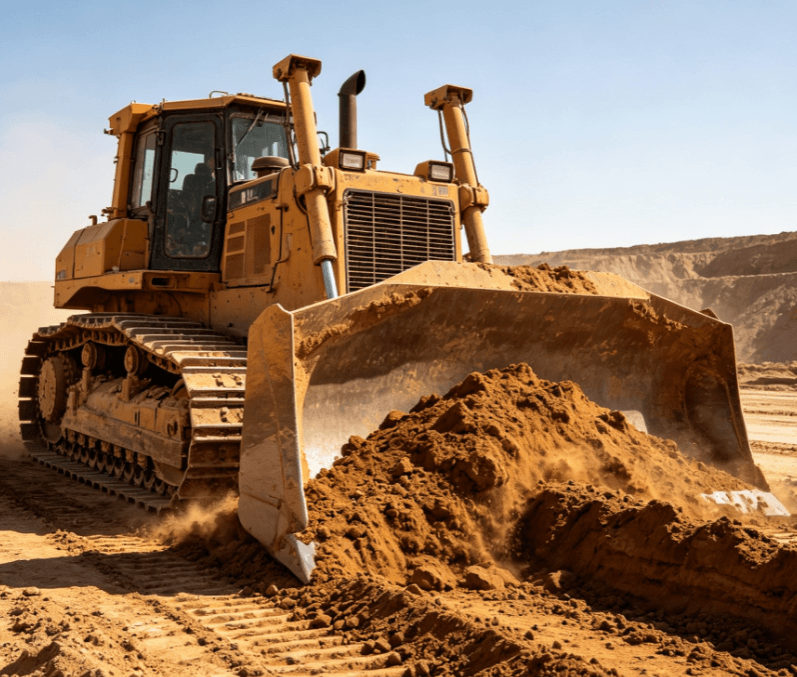
Drawbar pull is the net force available at the hitch or blade of a bulldozer to move a load. It is calculated as the Total Tractive Effort (the force generated at the track/ground interface) minus the Rolling Resistance (the force required to move the machine itself).
While “Tractive Effort” refers to the gross potential force generated by the drivetrain, “Drawbar Pull” is the usable force left over to do work, such as pushing soil, ripping rock, or towing a scraper.
The Physics of Pushing: Drawbar Pull vs. Engine Horsepower
A common misconception is that a higher-horsepower bulldozer will always push more than a lower-horsepower model. In reality, drawbar pull is often traction-limited rather than power-limited.
Why Horsepower Can Be Deceptive
Horsepower determines how fast a machine can do work (Force x Velocity). However, if a bulldozer does not have enough weight or traction to grip the ground, the tracks will spin, and that horsepower becomes wasted heat and tire/track wear.
- Power-Limited: Occurs when the engine stalls or the torque converter reaches maximum output before the tracks slip.
- Traction-Limited: Occurs when the engine has plenty of power, but the tracks lose their grip on the soil. Most bulldozer operations in soft or loose material are traction-limited.
Key Factors Affecting Bulldozer Drawbar Pull
To maximize drawbar pull, three engineering variables must be balanced:
1. Operating Weight
Weight is the “anchor” of tractive force. The maximum drawbar pull a machine can exert is mathematically capped by its weight multiplied by the coefficient of traction. This is why heavy-duty mining dozers, like those in the 100-ton class, are built with massive frames and heavy undercarriages—not just for durability, but to provide the downforce necessary for high-pull tasks like ripping.
2. Coefficient of Traction
The coefficient of traction (CoT) is the ratio between the maximum force the tracks can exert against the ground and the weight resting on those tracks.
| Ground Condition | Coefficient of Traction (Tracks) |
| Concrete | 0.45 |
| Clay (Dry) | 0.90 |
| Sand (Dry) | 0.30 |
| Quarry Pit / Rock | 0.55 – 0.65 |
| Loose Earth | 0.60 |
3. Transmission and Final Drive
The transmission (Powershift or Hydrostatic) and the final drive gear reduction convert high-speed engine rotation into high-torque track rotation. A bulldozer’s drawbar pull is highest in 1st Gear (lowest speed), as the gear ratio provides the maximum torque multiplication.
How to Calculate Bulldozer Drawbar Pull
Engineers use a standard formula to estimate available performance.
The General Formula:
Available Drawbar Pull = (Weight on Drive Components × Coefficient of Traction) – Rolling Resistance
- Rolling Resistance (RR): For tracked dozers, RR is generally estimated at 3% to 5% of the machine’s weight on firm ground, increasing significantly in soft mud or deep sand.
Example Calculation:
A bulldozer weighing 50,000 lbs operating on dry clay (CoT = 0.90):
- Gross Tractive Effort: 50,000 × 0.90 = 45,000 lbs.
- Rolling Resistance (at 4%): 50,000 × 0.04 = 2,000 lbs.
- Net Drawbar Pull: 45,000 – 2,000 = 43,000 lbs.
Drawbar Pull in Real-World Operations
Heavy Ripping vs. Bulk Pushing
When a bulldozer uses a rear ripper to break up shale or compacted soil, drawbar pull is the limiting factor. If the DBP is lower than the shear strength of the rock, the ripper will not penetrate or move forward. In these scenarios, operators often use “extreme service” grousers (track shoes) to bite deeper into the material, effectively increasing the CoT.
Managing Gradeability and Slopes
When working on an incline, a portion of the machine’s weight is redirected against the direction of travel.
- Grade Resistance: Approximately 20 lbs of pull is lost per ton of machine weight for every 1% of uphill grade.
- This means a bulldozer’s effective drawbar pull drops significantly when pushing material up a steep ramp.
How to Increase Drawbar Pull Performance
- Add Ballast: Adding counterweights or filling tires (for wheel dozers) increases the normal force on the ground.
- Optimize Grouser Choice: Use single-grouser shoes for maximum penetration in hard ground or wide “swamp” shoes to reduce ground pressure in soft silt (though wide shoes don’t always increase pull, they prevent the machine from sinking).
- Manage Blade Load: An experienced operator maintains a blade load that adds “downward” pressure to the front of the tracks, temporarily increasing traction during the push.
FAQ
Q: Is drawbar pull the same as torque?
A: No. Torque is a rotational force measured at the engine or axles. Drawbar pull is a linear force measured at the point of contact with the ground or the hitch.
Q: Why do wheel dozers have less drawbar pull than crawler dozers?
A: Wheel dozers have a lower coefficient of traction (usually 0.40–0.60) compared to tracks (0.60–0.90). Even if they have the same weight, the tracks’ “footprint” and grousers allow for much higher force before slipping.
Q: Does drawbar pull change with speed?
A: Yes. As travel speed increases (higher gears), available drawbar pull decreases. Maximum pull is always found at the lowest possible ground speed.
Reference Sources
Principles of Engineering (Heavy Equipment Physics): Standard curriculum for civil engineering and construction management.
Caterpillar Performance Handbook (Edition 49+): The industry standard for tractive effort and coefficient of traction tables.
SAE J701: Standard terminology for Agricultural and Industrial Tractors (Drawbar Pull definitions).
Hengwang Group Technical Support – Dozer Operational and Maintenance Documentation.