Choosing a crawler drilling rig factory involves more than comparing machine prices. International buyers also need to evaluate drilling performance, manufacturing capability, spare-parts support, delivery terms, and the supplier’s ability to meet project-specific requirements.
For contractors, distributors, construction companies, and procurement teams, a structured supplier evaluation can make it easier to compare manufacturers before moving from initial research to quotations and factory inspections.
This guide explains what to check when evaluating a crawler drilling rig manufacturer and how to prepare for an international equipment purchase.
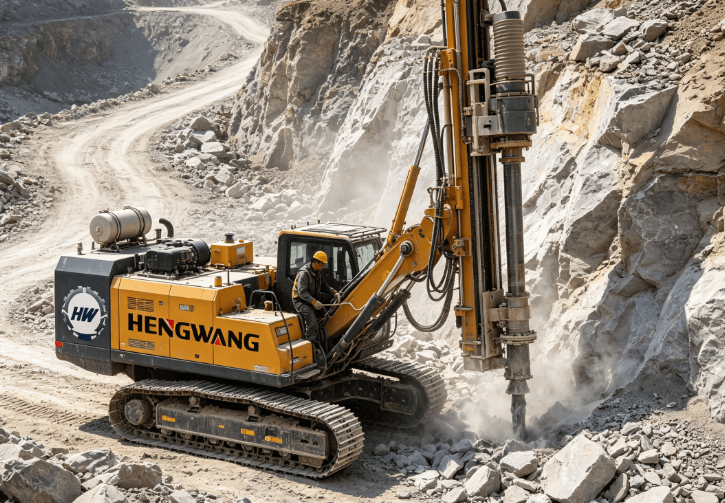
1. Define Your Drilling Requirements First
Before contacting a crawler drilling rig factory, define the operating conditions and machine requirements as clearly as possible.
At a minimum, consider:
- Required drilling depth and diameter
- Soil and rock conditions
- Drilling method and tooling
- Required rotary torque and feed force
- Engine or power requirements
- Working height and overall dimensions
- Crawler width and transport restrictions
- Drill rod and bit compatibility
- Expected operating hours
- Quantity and delivery schedule
A specification example can help illustrate why these details matter. The HW-160L Hydraulic Drilling Rig is published with a 160 m drilling depth, a 75–325 mm drilling diameter range, and 13.2 kW rated power. Its detailed page also lists different opening and final-hole dimensions, showing why buyers should review the complete specification rather than rely on a single headline figure.
For a broader comparison, the HengWang drilling rig product category provides access to different drilling equipment and configurations.
2. Check the Factory’s Actual Manufacturing Capability
A supplier describing itself as a factory does not, by itself, establish whether it is suitable for your project.
During the initial screening, ask about:
- Production facilities and assembly areas
- Main component sourcing
- Welding and machining processes
- Hydraulic and electrical assembly
- Factory testing procedures
- Quality inspection records
- Typical production lead times
- Previous orders for similar equipment
If a manufacturer provides ISO 9001 certification, buyers can verify the relevant documentation separately. ISO describes ISO 9001 as a quality management system standard that addresses areas such as process management, performance evaluation, documented information, and continual improvement. Certification can be useful evidence, but it should be considered alongside actual supplier and product checks.
3. Match the Machine Configuration to the Application
A specification sheet is useful for initial comparison, but the machine configuration should be evaluated against the intended drilling method, ground conditions, and site limitations.
For projects involving anchoring and foundation work, the Anchor Drilling Rig is one example of an application-specific crawler drilling solution. HengWang identifies the HW-135D as a crawler high-lift anchor drilling rig and lists applications including deep foundation pits, anchoring, jet grouting, and dewatering. The published headline specifications include a 150–250 mm drill diameter and 100–140 m drilling depth.
For surface drilling in harder formations, the HW936 Integrated DTH Surface Drill Rig provides another example of why application should guide equipment selection. The manufacturer lists 162 kW rated power, a 90–115 mm drilling diameter, 2,700 N·m maximum working torque, and 9,400 kg gross weight.
The point is not that one model is suitable for every project. Instead, buyers should compare drilling method, hole size, ground conditions, mobility, and required output before deciding which machine configuration to request from a factory.
4. Compare Spare Parts and After-Sales Support
For international buyers, after-sales support can influence the practical cost of operating a drilling rig.
Ask the factory for a recommended spare-parts list covering:
- Filters and service components
- Hydraulic components
- Wear parts
- Drilling tools
- Seals and hoses
- Electrical components
- Frequently replaced consumables
Also clarify:
- Parts availability
- Typical replenishment time
- Parts identification methods
- Technical documentation
- Operator training
- Remote troubleshooting
- Warranty scope and exclusions
For fleet purchases, it may be useful to negotiate an initial spare-parts package and a parts-replenishment process before shipment.
5. Review Export and Commercial Terms
A competitive machine price does not necessarily represent the lowest total procurement cost.
Ask the factory to identify, where applicable:
- Machine price
- Optional equipment
- Spare parts
- Export packing
- Inland transportation
- Port charges
- Freight
- Insurance
- Destination-related costs
The quotation should also identify the applicable Incoterms® 2020 rule and named location. The International Chamber of Commerce explains that Incoterms rules define responsibilities, costs, and risks between buyers and sellers in international trade.
For example, EXW, FCA, FOB, CIF, and DAP can allocate transport responsibilities and risk differently. Buyers should therefore compare quotations on the same commercial basis instead of focusing only on the equipment price.
6. Match Factory Strengths to Your Project
| Project situation | Main sourcing focus | Capabilities to verify |
|---|---|---|
| Single site or pilot project | Practical configuration, delivery time, training | Small-batch production, testing, export documentation |
| Multi-site project | Consistent specifications and parts supply | Production capacity, standardization, spare-parts planning |
| Specialized ground conditions | Drilling method, tooling, machine configuration | Engineering support, tooling options, testing capability |
| Distributor or reseller | Product range, documentation, service support | Training, spare-parts arrangements, technical documents |
| Long-term fleet purchase | Lifecycle cost and supplier support | Parts availability, production consistency, service response |
This approach allows buyers to evaluate a factory according to the actual purchasing scenario instead of selecting a supplier mainly because its advertised price is lower.
7. Use an RFI to Compare Suppliers Consistently
A concise Request for Information (RFI) can make supplier comparisons easier.
Your RFI should include:
Project information
- Destination country
- Application
- Ground conditions
- Expected drilling depth and diameter
- Estimated quantity
Machine requirements
- Required drilling method
- Power requirements
- Dimensions and transport limitations
- Tooling requirements
- Optional features
Commercial requirements
- Target delivery schedule
- Requested payment terms
- Incoterms
- Packaging requirements
- Spare-parts requirements
Ask each shortlisted factory to respond to the same requirements. This makes it easier to identify missing information, optional components, different assumptions, and meaningful price differences.
8. Verify the Factory Before Placing the Order
After reviewing RFI responses, shortlist suppliers for additional verification.
Depending on the order value and project requirements, this may include:
- Document review — company information, product specifications, certifications, and export documentation.
- Remote factory inspection — production areas, assembly processes, testing facilities, and finished equipment.
- On-site factory visit — particularly useful for larger orders or significant customization.
- Third-party inspection — an option for checking equipment before shipment.
- Reference checks — relevant export or application references where available.
The goal is not simply to confirm that a factory exists. It is to determine whether the supplier can provide the required machine configuration, documentation, and support within the agreed commercial framework.
9. Put Technical Requirements Into the Contract
Important requirements should not remain only in emails or informal conversations.
The purchase agreement should clearly identify:
- Final equipment configuration
- Main technical specifications
- Inspection and acceptance procedures
- Delivery schedule
- Packaging requirements
- Spare-parts package
- Warranty terms
- Payment milestones
- Documentation
- Incoterms and named delivery location
- Responsibilities for defects or non-conforming equipment
Instead of describing a machine as “high performance,” for example, specify measurable requirements that can be checked during inspection or acceptance testing.
This gives both parties a clearer reference if questions arise during production or delivery.
Crawler Drilling Rig Factory Buyer Checklist
Before making a supplier decision, confirm that you have answers to the following:
- Does the machine match the actual drilling conditions?
- Are the main performance specifications clearly defined?
- Are optional components identified separately?
- Has the factory provided a realistic production lead time?
- Are spare parts available for the expected operating period?
- Are warranty and service responsibilities documented?
- Has the supplier’s manufacturing capability been verified?
- Are inspection and acceptance criteria agreed?
- Are export documents and packaging requirements clear?
- Are Incoterms and shipping responsibilities specified?
- Does the quotation allow a fair comparison with other suppliers?
If several questions remain unanswered, completing the supplier-verification stage before placing an order may be worthwhile.
.png)
Frequently Asked Questions
How do I verify a crawler drilling rig factory?
Start with company and product documentation, then compare the supplier’s technical response with your project requirements. For shortlisted suppliers, consider a remote or on-site factory inspection, product testing, and reference checks where appropriate.
What should I ask a crawler drilling rig manufacturer before requesting a quotation?
Provide the intended application, ground conditions, drilling depth and diameter, quantity, destination, delivery schedule, and tooling requirements. Clear requirements make it easier for suppliers to prepare comparable quotations.
Can a crawler drilling rig be customized?
Customization may be available depending on the manufacturer and machine configuration. Discuss the required changes before quotation and confirm their effect on price, lead time, testing, spare parts, and warranty.
How should I compare crawler drilling rig prices?
Compare machines on an equivalent specification and commercial basis. Include optional equipment, spare parts, packaging, freight, insurance, import-related costs, and applicable Incoterms rather than comparing the base machine price alone.
Where can I review drilling rig models before contacting a factory?
You can begin with the HengWang drilling rig product category and then review individual models according to your application. The category currently includes crawler, anchoring, reverse-circulation, pneumatic, and other drilling equipment, so model-specific specifications should be confirmed before requesting a quotation.
Final Takeaway
Selecting a crawler drilling rig factory is best approached as a supplier-verification process rather than a simple price comparison.
Define the drilling requirements first, compare manufacturers using the same RFI, verify production and quality processes, review spare-parts and after-sales arrangements, and clarify export and contract terms before placing an order.
For buyers researching potential equipment options, the HengWang drilling rig product category provides a practical starting point for reviewing available models and preparing more specific supplier questions.