Excavator sizes are often chosen by tonnage alone, and that can be expensive. A machine may have enough digging force for the work but still be too wide for the access route, too short on reach, or impractical to transport between sites. The opposite problem is just as common: a compact machine reaches the job easily but spends too much time repositioning, loading, or working at the edge of its capability.
Excavator sizes are usually described by operating weight, yet that figure is only a first filter. The final choice has to account for the working envelope, tail swing, lift chart, attachments, soil conditions, and the way the machine will be mobilized.
The chart below is designed to make that comparison easier. It uses practical planning bands rather than rigid global definitions, because manufacturers and markets do not draw every class boundary in the same place.
.png)
Excavator size chart: practical planning bands
One widely used dealer classification places mini excavators below 10 metric tons, then groups full-size machines as small at 11–19 t, medium at 20–35 t, and large at 36–90 t.1 Those labels are useful for narrowing a shortlist, but the specification sheet for the actual model still decides whether it fits the work.
| Size class | Typical operating-weight planning band | Where the class is commonly used | Checks that matter most |
|---|---|---|---|
| Mini / micro | Under 2 t | Backyards, interior demolition, light trenching, landscaping, and restricted access | Transport width, retractable-track width, dig depth, attachment hydraulics, trailer capacity |
| Compact / midi | 2–10 t | Utilities, drainage, small commercial work, site preparation, and mixed attachment use | Tail swing, lift chart, reach, auxiliary flow, access route, and transport plan |
| Small full-size | 11–19 t | General construction, foundations, heavier trenching, loading, and sustained daily production | Work range, bucket match, ground bearing, site circulation, and mobilization |
| Medium | 20–35 t | Civil work, bulk excavation, pipeline projects, larger foundations, and production loading | Lift capacity at the required radius, reach and depth, support equipment, route restrictions |
| Large | 36–90 t | Major infrastructure, quarry support, high-volume earthmoving, and long-reach applications | Ground preparation, fleet match, transport logistics, attachment/load requirements, production targets |
Within every band, configuration matters. A longer arm can improve reach but alter lifting performance. A heavier counterweight can support certain duties but changes transport requirements. Track width, boom geometry, bucket size, and tail-swing design all affect how a machine behaves on a real site.
What operating weight tells you—and what it does not
Operating weight broadly signals the machine’s physical scale and influences transport, ground pressure, and stability. It also has a relationship with lifting behavior: as excavator size changes, so do its center of gravity, lift geometry, and counterweight.2 That is why a weight class is useful at the start of a buying decision.
It does not tell you the whole story. Two excavators with similar operating weights can have different maximum dig depths, working radii, tail-swing envelopes, hydraulic outputs, and approved lift capacities. If lifting pipes, structures, or work tools is part of the assignment, compare the actual lift chart at the intended radius and height. A machine’s maximum figure is not automatically its working figure.
For an early look at available machine types, the Hengwang excavator category covers mini, crawler, and wheeled excavators. Final selection should be based on the documented configuration, not on a product name or class label.
Measure the job before comparing models
The most reliable selection process starts with the site, not a brochure. Map the narrowest access point, the available swing space, the excavation geometry, and the material that must be moved. Then record how the excavator will arrive, where it will unload, and whether it will need to work beside an open excavation, a building, traffic, or existing services.
Access and transport dimensions
Overall transport width is often the first constraint on compact jobs. Gates, service alleys, bridge approaches, and urban worksites can rule out a machine before digging starts. Height and length matter just as much during loading and transport. Check the configured transport dimensions, including the boom position and any attachment that will travel with the machine.
For compact-machine dimensions in the lower weight bands, Hengwang’s mini excavator size chart provides a focused companion resource. Use it when a narrow track width or trailer limit is likely to determine the choice.
The working envelope
Dig depth is a familiar specification, but it can be misleading when taken in isolation. A trench may require vertical-wall depth rather than maximum depth. A foundation excavation may require reach across an obstacle. Loading trucks may depend on dump height and swing clearance. Write down the depth, reach, loading height, and working radius before requesting a recommendation.
Soil, slope, and work cycle
Loose material, hard clay, fragmented rock, wet ground, and steep slopes place different demands on the machine. A larger bucket is not automatically a faster answer if the material is dense or the site limits swing speed. Similarly, a light excavator may be ideal on finished landscaping but inefficient on a project with a long daily loading cycle.
Excavation planning is also a safety matter. In the United States, OSHA requires the estimated location of underground utilities that may reasonably be encountered to be determined before an excavation is opened.3 Projects elsewhere should follow the relevant local utility-location and excavation-safety requirements before work begins.
Mini and compact excavators: access first, then capability
Mini and compact machines earn their place where access, maneuverability, or surface protection are the dominant concerns. They are well suited to landscaping, utility repair, drainage, small foundations, and work inside constrained commercial or residential areas. Their smaller footprint can simplify mobilization and reduce disruption, but it also narrows the margin for heavy lifts and high-production tasks.
Do not assume that every compact excavator handles the same attachments or lifts the same load. Auxiliary-hydraulic requirements, coupler weight, arm length, and tail-swing design can change the practical result. A separate mini excavator selection guide can help when the decision is mainly between compact configurations rather than between compact and full-size equipment.
When a medium or large excavator is justified
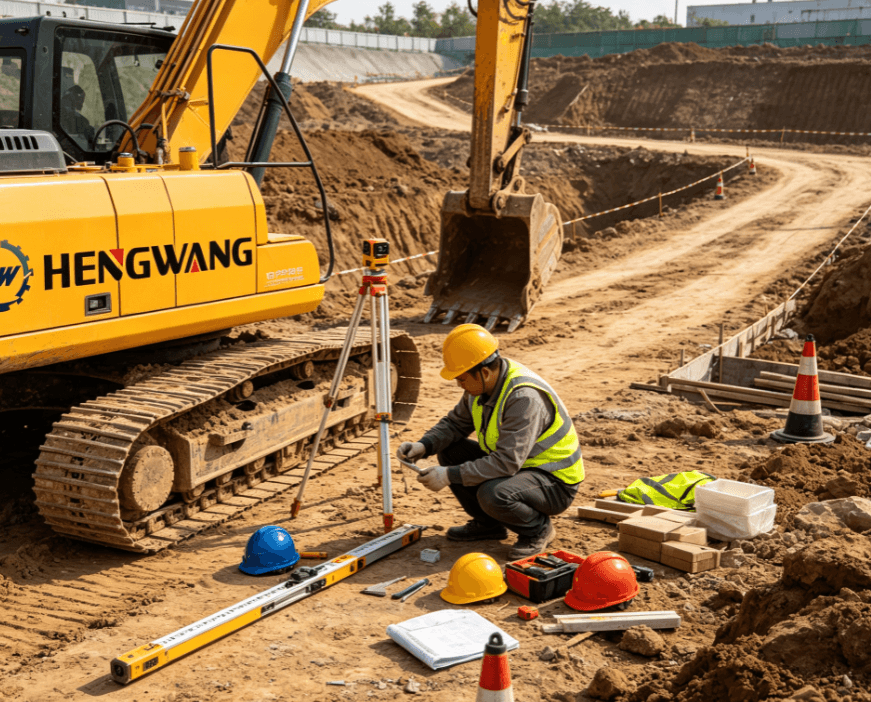
Move into the medium and large classes when the work requires sustained output, a larger work envelope, or better stability for the planned digging and loading cycle. Civil construction, substantial foundations, pipeline work, bulk excavation, and quarry-support tasks often make that case.
At this scale, mobilization should be assessed as carefully as production. Transport equipment, route permissions, unloading space, ground preparation, fuel and service access, and room for support machines can all influence the total cost of using a larger excavator. A class that looks efficient in isolation can become costly if it causes repeated access or logistics delays.
Tracks or wheels can change the size decision
Machine size is not the only decision. The undercarriage determines how the excavator moves through the site and how readily it can travel between working areas. Crawler excavators are typically considered for traction and stability on uneven ground, while wheeled excavators can suit hard surfaces and projects that benefit from more frequent travel. The trade-offs deserve a separate review; see Wheeled vs Crawler Excavator: Which Is Best for Your Project? for a focused comparison.
A practical sizing brief for suppliers
A useful enquiry gives the supplier enough context to recommend a configuration rather than guess from a single tonnage request. Include the following details:
- The main work: trenching, loading, demolition, lifting, grading, or attachment work.
- Required dig depth, vertical-wall depth, reach, loading height, and working radius.
- The material to be excavated or handled, plus expected daily production.
- The narrowest access width, height restrictions, available turning space, and transport method.
- Ground conditions, slopes, trench-edge conditions, and any constraints from existing utilities or structures.
- Required buckets, couplers, breakers, augers, grapples, or other attachments.
- Any planned lifting duty, including the load weight, lift height, lift radius, and attachment.
That brief makes it easier to compare like with like. It also gives the supplier a basis for confirming whether the final machine configuration is appropriate for the work.
FAQ
How do I choose the right excavator size?
Start with site access and the work envelope, then set a weight-class shortlist. Compare the individual models against required depth, reach, lift chart, attachment needs, ground conditions, and transport limits. Choose the smallest class that can perform the recurring task without operating at the edge of its capability.
Are excavator weight classes standardized?
No. Terms such as mini, compact, midi, small, standard, medium, and large vary between manufacturers and markets. Use the class as a planning shortcut, then check the specific model’s documented dimensions and performance data.
Which excavator size is best for a tight-access site?
Mini and compact excavators are usually the first machines to assess. Measure the narrowest point on the entire access route, not only the entrance, and confirm tail-swing clearance, transport dimensions, and the working space required once the machine is inside.
Does a larger excavator always lift more?
Size and weight can improve stability, but the safe capacity for a particular lift depends on configuration, radius, height, attachment, ground conditions, and the approved lift chart. Check the chart for the exact machine and intended working condition.
Choose the class, then verify the configuration
An excavator size chart can narrow the options quickly, but it should not replace the final specification review. Match the machine to the access route, excavation geometry, daily work cycle, attachments, lifting requirement, ground conditions, and transport plan. Once a likely class is identified, confirm the final specification with Hengwang before making the project decision.